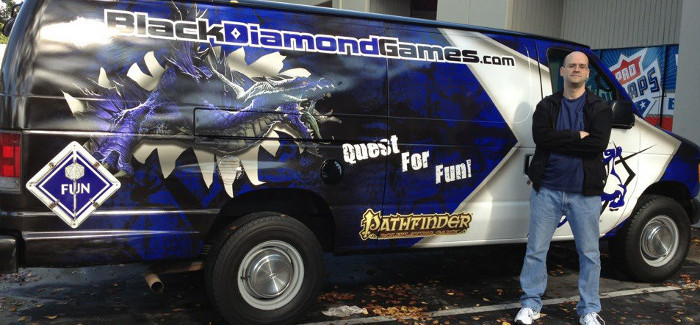
They'll tell you that you can't have a game store. It can't be done. Retail is dead, so do what you can to sell lots of Cokes and candy bars, if you must, but nobody will actually buy games from you. Because Internet. This was common sentiment on a Reddit thread recently.
They'll tell you you'll be giving up your current livelihood, and no matter how long it takes you, the opportunity costs will be harsh. In my late 30's and 40's, I was told I was giving up my peak earning years. This is true.
Once you have a store, they'll tell you failure is imminent. The competitor has been there for 20 years. The store down the street does Magic better, does 40K better, has a better selection of Yugioh singles. How can you possibly compete?
When your competitors fail, one by one, those same people will have logical reasons for why they fail having nothing to do with the management of that business. Well, that Games Workshop store had difficult demographics, which is why they're gone. It's hard to steer a narrative. When a store is gone, they're gone. Call it a failure if you want, but they're still gone.
They will continue to be surprised when you are stubborn enough not to die. The property manager for my old landlord confided in me that they both thought I would fail well before my lease was up. How surprising I'm still in business! Why ... thank you. Customers would visit my old store in years two and three and express shock at my continued existence. Imagine someone coming into your work every day and expressing surprise you haven't been fired.
When you succeed, they begin to make excuses for why you succeeded. Other store owners will point to your superior demographics. Oh, you might have something to teach us, but your demographic doesn't match ours. Your success is special. You're an outlier, a corner case. Psst, demographics is also a choice.
They will credit the economy, the housing boom, for example, but will not give you credit for surviving the economic crash, like 9/11 or the financial meltdown. They will instead call you counter-cyclical. Well, of course you do well in a bad economy, it's a flight to value, and of course you do well in a recovering economy, people have money to spend again.
They will give all the credit to your staff, as they are the ones truly running the business. I often think of myself as the Venkman of game store owners, so I'm happy to give away that credit. They will see me come in and work my 35 hours a week at the store, but not see my 20 at home. Like the tree with invisible roots.
They will think you are lying about all of it, question your numbers, and poke at your business model to see if it deflates. They will give you bad reviews online for the sake of punishing hubris and they'll send their rejects to you to rattle your cage.
They will start protest stores, because you don't love them as much as they deserve. Then they will fail and blame you.
The truth, the reality of why I'm still in business, is I don't fall down as often as my competitors. It's a game of attrition. I don't discount, so I have resources. I don't cheat my customers, so I have growth. I hire good people and pay them well, honestly, and above board, and they grow the business. We take small chances and try new things and keep the things that work. It's not rocket science, it's just failure avoidance. What's the secret of flying? According to Douglas Adams, you "throw yourself at the ground and miss." That's small business in a nutshell.
I've had enormous boons and resources, including growing up with well educated parents with the best public schools in the country and a free college education (thanks to those parents). I've got well educated friends who understand business who could help me through the process. I had access to easy capital before the financial crisis. There are a lot of reasons I should be thankful and give credit to others, but those reasons aren't what they want to talk about.
Tuesday, May 21, 2013
Sunday, May 19, 2013
The Impossible Employee
People like to complain about service in this country. It's practically an art form, with Hipster hangouts like Yelp existing so people can out smarm their friends about the shortcomings of small business. We know big business fails, but small business offers so many new variations on the form. Just today I could write a blog post about the annoying Fox News playing on the TV (I don't want around) at my diner or the lecture I received about pumping gas and hose tension at my usual gas station. There's no limit to this.
Service is uneven for a reason. It comes down to compensation and what it takes to get someone to work a retail or service job, and their inevitable leaving.
My store is hiring right now. Honestly, we've been short staffed for many months at this point. We're always hiring. My problem is I can't find qualified employees, despite an 8.1% unemployment rate in our county. When I say qualified, what I'm referring to is a nearly impossible set of circumstances that rules out all but a particular type of potential employee.
So what does it take to be an employee? Employees, first and foremost, need to have reliable transportation, both to work and to the bank afterwards to make deposits. I'm not allowed to say they have to have a car, but buses aren't running after we close.
I don't offer health insurance, so that's pretty much on them. Heck, I don't offer it to myself. Imagine the UK, where universal healthcare is a huge benefit to retail and small business.
Employees have to have a flexible, part time schedule, meaning the job likely won't pay rent on its own. We're pretty good about keeping schedules regular. Businesses with rotating schedules are evil, horrible places with lazy managers. Shame on them.
Employees need to be well spoken, appropriately dressed, and fairly well educated and able to communicate electronically with staff and often customers. I can't require they have smart phones, but since they all do, we have systems in place that leverage that, like our backup Square credit card readers.Yeah, I don't pay for that either.
They will be required to learn new skills, improvise on the job, and generally read my mind. They'll get emails day and night from me that they'll need to figure out how to deal with as part of their job responsibilities and hours. That's not an extraordinary part of the job, those are base requirements, and I do expect them to get compensated for this time.
They'll all need to be at least 18 years of age, so they can work alone at times. Some will leave because they feel overwhelmed by the solo gig, or creeped out by having to make bank deposits at midnight (alright, I'm describing me).
In exchange, they will be paid an hourly rate of around $9-10, even if they're a manager. Managers mostly get more responsibility with a token raise in pay. It's a resume booster for later.
So mostly who we're talking about is college "kids", adults who are subsidized by other adults (who thus subsidize my business). Although I've had some employees for years, and I would love to have them all for years to come, all employees working for me are on there way to something else, something better. Sure, I could hire lifelong retail people, but they wouldn't fit my high requirements or the generally unrealistic demands of my customers. They certainly wouldn't put up with my crap for what I'm paying them, and occasionally we'll get an applicant who didn't understand that.
So I seek out these niche people, who, by the way, must have retail experience already. I prefer to have someone else do their basic training. I want to see a resume, not some cheesy application form. It should impress me with past experience, and to get to the top of the pile, it should have something extraordinary. Eagle Scouts get top pick for men. Being female and knowledgeable about games is somewhat equivalent in rarity and desirability. I don't want to down play the female requirements, in fact their higher level of maturity alone eliminates the myriad of problems I have with young guys.
I can do this, being incredibly picky for essentially a sales clerk position, because being around things you love is a wonderful thing. There are toilets to scrub, annoying children to wrangle, and plenty of work to do, even when it's slow, it's still a way better job than anything I had in college. For the most part, you get to share your passion about what you love. Also, if I'm doing my job right as a manager, I'm handing out challenging projects and tasks that engage employees, rather than expecting a counter monkey. The biggest insult you can give to a retail employee is ignore them, or allow them to do homework or play video games on the clock. That's a truly pointless job, and they'll perform pointlessly in response.
So there are opportunities, if we find the right match. Of course, most people who apply think it's standing behind the counter pontificating. Hey, I had to vacuum a lot of floors to get that pontification position. In the end though, everyone will leave. We'll start over with the new person. We'll have new and different problems, err, I mean training opportunities. Ideally, we get better at expressing what we want up front. I've learned to let someone go as quickly as possible if it's not working out, and because I really despise letting people go, I've become much pickier on hiring.
And while we go through this process, some jackass hipster will write a scathing Yelp review about how a staff member hadn't heard of their favorite game from ten years ago or looked at them funny, or wouldn't date them. And we'll all lament about the death of retail and wonder why game stores still exist. Sell more sodas is what they'll tell us, because it certainly can't be about selling games.
Service is uneven for a reason. It comes down to compensation and what it takes to get someone to work a retail or service job, and their inevitable leaving.
My store is hiring right now. Honestly, we've been short staffed for many months at this point. We're always hiring. My problem is I can't find qualified employees, despite an 8.1% unemployment rate in our county. When I say qualified, what I'm referring to is a nearly impossible set of circumstances that rules out all but a particular type of potential employee.
So what does it take to be an employee? Employees, first and foremost, need to have reliable transportation, both to work and to the bank afterwards to make deposits. I'm not allowed to say they have to have a car, but buses aren't running after we close.
I don't offer health insurance, so that's pretty much on them. Heck, I don't offer it to myself. Imagine the UK, where universal healthcare is a huge benefit to retail and small business.
Employees have to have a flexible, part time schedule, meaning the job likely won't pay rent on its own. We're pretty good about keeping schedules regular. Businesses with rotating schedules are evil, horrible places with lazy managers. Shame on them.
Employees need to be well spoken, appropriately dressed, and fairly well educated and able to communicate electronically with staff and often customers. I can't require they have smart phones, but since they all do, we have systems in place that leverage that, like our backup Square credit card readers.Yeah, I don't pay for that either.
They will be required to learn new skills, improvise on the job, and generally read my mind. They'll get emails day and night from me that they'll need to figure out how to deal with as part of their job responsibilities and hours. That's not an extraordinary part of the job, those are base requirements, and I do expect them to get compensated for this time.
They'll all need to be at least 18 years of age, so they can work alone at times. Some will leave because they feel overwhelmed by the solo gig, or creeped out by having to make bank deposits at midnight (alright, I'm describing me).
In exchange, they will be paid an hourly rate of around $9-10, even if they're a manager. Managers mostly get more responsibility with a token raise in pay. It's a resume booster for later.
So mostly who we're talking about is college "kids", adults who are subsidized by other adults (who thus subsidize my business). Although I've had some employees for years, and I would love to have them all for years to come, all employees working for me are on there way to something else, something better. Sure, I could hire lifelong retail people, but they wouldn't fit my high requirements or the generally unrealistic demands of my customers. They certainly wouldn't put up with my crap for what I'm paying them, and occasionally we'll get an applicant who didn't understand that.
So I seek out these niche people, who, by the way, must have retail experience already. I prefer to have someone else do their basic training. I want to see a resume, not some cheesy application form. It should impress me with past experience, and to get to the top of the pile, it should have something extraordinary. Eagle Scouts get top pick for men. Being female and knowledgeable about games is somewhat equivalent in rarity and desirability. I don't want to down play the female requirements, in fact their higher level of maturity alone eliminates the myriad of problems I have with young guys.
I can do this, being incredibly picky for essentially a sales clerk position, because being around things you love is a wonderful thing. There are toilets to scrub, annoying children to wrangle, and plenty of work to do, even when it's slow, it's still a way better job than anything I had in college. For the most part, you get to share your passion about what you love. Also, if I'm doing my job right as a manager, I'm handing out challenging projects and tasks that engage employees, rather than expecting a counter monkey. The biggest insult you can give to a retail employee is ignore them, or allow them to do homework or play video games on the clock. That's a truly pointless job, and they'll perform pointlessly in response.
So there are opportunities, if we find the right match. Of course, most people who apply think it's standing behind the counter pontificating. Hey, I had to vacuum a lot of floors to get that pontification position. In the end though, everyone will leave. We'll start over with the new person. We'll have new and different problems, err, I mean training opportunities. Ideally, we get better at expressing what we want up front. I've learned to let someone go as quickly as possible if it's not working out, and because I really despise letting people go, I've become much pickier on hiring.
And while we go through this process, some jackass hipster will write a scathing Yelp review about how a staff member hadn't heard of their favorite game from ten years ago or looked at them funny, or wouldn't date them. And we'll all lament about the death of retail and wonder why game stores still exist. Sell more sodas is what they'll tell us, because it certainly can't be about selling games.
Wednesday, May 15, 2013
Our Reaper Relationship
Back in August of last year, Reaper Miniatures raised $3.4 million, the biggest hobby game Kickstarter project at the time. The question was raised whether this direct to consumer appeal would undermine our brick and mortar local market, whether we would dump Reaper out of protest, or whether this would just whet the appetite of alpha customers and grow the market. It turns out to be far more complicated.
We've since dropped our Reaper paints, the full line of Master Series paints that it took months to initially bring in. We've also dropped a bunch of stock, and we're down about 70% from last August. Was it protest? Animosity? The death of a local market? None of that. It was about Reaper being unable to "fill" their product lines. They've ceded the market by not having the resources to continue their normal operations at the same time as their Kickstarter Bones initiative.
Our miniature selection is down 50%, and when our paint selection dropped by a third, we knew it was time to let that go. Reaper left us, we didn't leave them. Some rumors state they're in trouble due to miscalculation of shipping on the Bones project, but the reasons are not my primary concerns. So like a parting couple, I want to set the record straight with my friends, it was their idea.
On the bright side, as the stock dwindled down, we were able to take a closer look at our Reaper strategy, re-evaluating our relationship. Items and sections of our "wall of lead" came into sharper focus. Maybe the relationship wasn't so great after all. We decided to dump various sections as the dregs came into view. It went beyond tactical inventory management and more into strategy. Reaper has gotten a free pass for years, mostly because I'm at heart an 80's era RPG enthusiast, and Reaper is a huge part of that legacy. It would be like growing up with a poster of a super model on your wall and then getting to date her as an adult, only to find she's not as amazing as you thought.
The reality is RPGs, as much as I love them, are a dwindling sideline. D&D is dormant, Pathfinder has peaked for us (although it's still very strong), the second wave 90's games have gone direct, and we have a heck of a time trying to break into the indie scene with our local demographics. If RPGs are a sideline, then paintable miniatures is an even smaller subset of that. Again, there is love there, that supermodel will always be in my heart, but Reaper really doesn't belong in game stores, I would argue, not one that appreciates modern concepts of inventory efficiency, or you know, a strong relationship.
We're not going to drop Reaper, although it's not like I can call someone and get the 155 back ordered miniatures I want from them. What we will do is re-allocate some of that space to other companies, other projects, hopefully some other games. We're going to reboot Malifaux with version 2 of those rules and their plastic reboot. They're also a nice cross-over miniature for RPGs. What we won't do is give Reaper a free pass any longer. It would be easy to cheer a little at their misfortune, but I actually like this company, and if they want to leave me and see other people, I'll respect that. I just don't want to be jerked around.
We've since dropped our Reaper paints, the full line of Master Series paints that it took months to initially bring in. We've also dropped a bunch of stock, and we're down about 70% from last August. Was it protest? Animosity? The death of a local market? None of that. It was about Reaper being unable to "fill" their product lines. They've ceded the market by not having the resources to continue their normal operations at the same time as their Kickstarter Bones initiative.
Our miniature selection is down 50%, and when our paint selection dropped by a third, we knew it was time to let that go. Reaper left us, we didn't leave them. Some rumors state they're in trouble due to miscalculation of shipping on the Bones project, but the reasons are not my primary concerns. So like a parting couple, I want to set the record straight with my friends, it was their idea.
On the bright side, as the stock dwindled down, we were able to take a closer look at our Reaper strategy, re-evaluating our relationship. Items and sections of our "wall of lead" came into sharper focus. Maybe the relationship wasn't so great after all. We decided to dump various sections as the dregs came into view. It went beyond tactical inventory management and more into strategy. Reaper has gotten a free pass for years, mostly because I'm at heart an 80's era RPG enthusiast, and Reaper is a huge part of that legacy. It would be like growing up with a poster of a super model on your wall and then getting to date her as an adult, only to find she's not as amazing as you thought.
The reality is RPGs, as much as I love them, are a dwindling sideline. D&D is dormant, Pathfinder has peaked for us (although it's still very strong), the second wave 90's games have gone direct, and we have a heck of a time trying to break into the indie scene with our local demographics. If RPGs are a sideline, then paintable miniatures is an even smaller subset of that. Again, there is love there, that supermodel will always be in my heart, but Reaper really doesn't belong in game stores, I would argue, not one that appreciates modern concepts of inventory efficiency, or you know, a strong relationship.
We're not going to drop Reaper, although it's not like I can call someone and get the 155 back ordered miniatures I want from them. What we will do is re-allocate some of that space to other companies, other projects, hopefully some other games. We're going to reboot Malifaux with version 2 of those rules and their plastic reboot. They're also a nice cross-over miniature for RPGs. What we won't do is give Reaper a free pass any longer. It would be easy to cheer a little at their misfortune, but I actually like this company, and if they want to leave me and see other people, I'll respect that. I just don't want to be jerked around.
Monday, May 6, 2013
Fair Taxation
It's kind of dumb I feel compelled to write a post about the fairness of the Marketplace Fairness Act, but the closer this issue hits my demographic, the more misunderstanding I see. The youths, they are appalled.
Here's the thing: If you buy something online, you are legally obligated to pay sales tax on it. If you don't report it on your state income taxes, you're evading the tax. Few people do this, and honestly, I'm not super orthodox religious about it either, although I'm meticulous when it comes to the store's finances.
For what it's worth, I at least know better. To gnash your teeth about having to pay this tax is to be angry you can no longer break the law with impunity. I see why you might not like it, but to publicly decry it is to be kind of a douche. Pay you're freakin' taxes already or shut up about being a scofflaw.
The fairness part of this tax refers to the fact that my store must collect sales tax, currently at a combined 9% rate, while most online businesses out of state do not. That's essentially a 9% discount before the typical online devaluation even begins. Sure, I can go online and screw over the tax base of other states, but that's not the point. A level playing field means tax is collected across the board, not only where enforcement is effective.
We tend to give new technology a pass on the rules, allowing them to skip taxes, possibly because they claim they're some sort of charity, like a holy prostitute. We do this because this country loves the new, but it's time for some old fashioned fairness.
If you don't like sales tax, find a way to increase revenue to cover the roads, police, schools and other services you benefit from daily. Californians pay some of the highest sales tax in the country, while other taxes, like real estate, are very low. We're in the top ten for sales tax, depending on how you calculate it, and 39th for real-estate. You can see who this hurts the most, those who can least afford it. That's typical California though. However, if it makes you feel better, our effective tax rate is pretty low compared to other developed countries.
Here's the thing: If you buy something online, you are legally obligated to pay sales tax on it. If you don't report it on your state income taxes, you're evading the tax. Few people do this, and honestly, I'm not super orthodox religious about it either, although I'm meticulous when it comes to the store's finances.
For what it's worth, I at least know better. To gnash your teeth about having to pay this tax is to be angry you can no longer break the law with impunity. I see why you might not like it, but to publicly decry it is to be kind of a douche. Pay you're freakin' taxes already or shut up about being a scofflaw.
The fairness part of this tax refers to the fact that my store must collect sales tax, currently at a combined 9% rate, while most online businesses out of state do not. That's essentially a 9% discount before the typical online devaluation even begins. Sure, I can go online and screw over the tax base of other states, but that's not the point. A level playing field means tax is collected across the board, not only where enforcement is effective.
We tend to give new technology a pass on the rules, allowing them to skip taxes, possibly because they claim they're some sort of charity, like a holy prostitute. We do this because this country loves the new, but it's time for some old fashioned fairness.
If you don't like sales tax, find a way to increase revenue to cover the roads, police, schools and other services you benefit from daily. Californians pay some of the highest sales tax in the country, while other taxes, like real estate, are very low. We're in the top ten for sales tax, depending on how you calculate it, and 39th for real-estate. You can see who this hurts the most, those who can least afford it. That's typical California though. However, if it makes you feel better, our effective tax rate is pretty low compared to other developed countries.
Tuesday, April 30, 2013
Invasive Species
The ecosystem has recovered nicely. The circle of life is stronger than it has been in years. What? What is it you say? You would like to introduce a new species into the mix, one that's not native to these lands? Oh, and it competes with the creatures in the existing ecosystem? And it's biologically less efficient? Now why would I want to do that?
That's exactly the case with collectible card games. A community can at most support a handful of CCGs before it begins to fragment, break down and spin out of control. Each game store owner knows how many games, exactly, they can support, and each knows precisely what those games are. For us it's Magic, Yugioh, Cardfight Vanguard and Pokemon. Add another game and I'm more than likely sucking the resources, customers and event space, from an existing game or just spinning my wheels. For other store owners, it may be three games or six, and they might be different, but we all know what they are.
It takes a tremendous amount of effort for a store to get a CCG off the ground. It includes volunteers, staff time, inventory resources, dedicated high value play space, and a ton of marketing. A dead collectible card game is the only thing we'll ever throw in the trash.
As for what gets introduced, there are predatory companies with poor margins like Upper Deck where it makes no sense whatsoever to even risk their new games. They are the worst of an invasive species, one that sucks the resources from vibrant species and leaves the environment worse for wear. Dollar for dollar, I'm poorer, plus I know from experience, I will curse their name on a weekly basis.
Game companies want very much for us to take this risk, to introduce the new species, whether it's a new superhero game from Upper Deck, the re-skinned Duel Masters (Kaijudo), the super high tech but no street cred whatsoever Redakai, or the "other" game from Bushiroad, Weiss Schwarz. If customers start asking for it, we'll certainly consider a new CCG, but oh my god is this a dangerous game to play.
Right now we're in a CCG bubble, a highly profitable period where it feels almost like a race to accomplish financial goals. Pay off debt, repair and replace old FFE's (furniture, fixtures and equipment), build out new spaces, and possibly, maybe, put some money aside for the future. Game stores, for the first time I've ever seen (in nearly 9 years) are acting like real businesses. They have capital and staff and ideas and they're doing new and interesting things. Nobody wants to pop that bubble with some dangerous, sharp edged new things.
That's exactly the case with collectible card games. A community can at most support a handful of CCGs before it begins to fragment, break down and spin out of control. Each game store owner knows how many games, exactly, they can support, and each knows precisely what those games are. For us it's Magic, Yugioh, Cardfight Vanguard and Pokemon. Add another game and I'm more than likely sucking the resources, customers and event space, from an existing game or just spinning my wheels. For other store owners, it may be three games or six, and they might be different, but we all know what they are.
It takes a tremendous amount of effort for a store to get a CCG off the ground. It includes volunteers, staff time, inventory resources, dedicated high value play space, and a ton of marketing. A dead collectible card game is the only thing we'll ever throw in the trash.
As for what gets introduced, there are predatory companies with poor margins like Upper Deck where it makes no sense whatsoever to even risk their new games. They are the worst of an invasive species, one that sucks the resources from vibrant species and leaves the environment worse for wear. Dollar for dollar, I'm poorer, plus I know from experience, I will curse their name on a weekly basis.
Game companies want very much for us to take this risk, to introduce the new species, whether it's a new superhero game from Upper Deck, the re-skinned Duel Masters (Kaijudo), the super high tech but no street cred whatsoever Redakai, or the "other" game from Bushiroad, Weiss Schwarz. If customers start asking for it, we'll certainly consider a new CCG, but oh my god is this a dangerous game to play.
Right now we're in a CCG bubble, a highly profitable period where it feels almost like a race to accomplish financial goals. Pay off debt, repair and replace old FFE's (furniture, fixtures and equipment), build out new spaces, and possibly, maybe, put some money aside for the future. Game stores, for the first time I've ever seen (in nearly 9 years) are acting like real businesses. They have capital and staff and ideas and they're doing new and interesting things. Nobody wants to pop that bubble with some dangerous, sharp edged new things.
Saturday, April 27, 2013
Selling Out
Selling out is only a virtual when the supply of your product is limited. Selling out of hand made cupcakes, a product that will be obsolete tomorrow, is a great thing. That last hotel room for the night should be sold, as it won't have any value tomorrow, as is a seat on a departing airplane. Print runs of magazines are in a similar category. Yes, perhaps you should have printed more, but an old magazine is about as popular as yesterdays hotel room. You should do whatever it takes to sell out of these products, short of free.
It's not a virtue to sell out of your everyday product. When demand exceeds supply of a board game, card game release, or role playing book, you have failed to gauge the marketplace. You have left money on the table, you've under performed. You've treated your product like that hotel room from yesterday, like the hot potato of last months magazine. You're not making cupcakes, cupcake.
If this is a strategy, your company is under capitalized and your marketing budget is going to waste, promoting items that may or may not exist as you carefully turn people into potential customers through repeated exposure. They say it takes nine impressions before a prospect becomes a customer. Do you really want your product gone as the counter ticks over to nine? What a tremendous waste. Of course this assumes you're trying to be a profitable company, that you have a marketing budget. The game trade is peculiarly resistant to these arcane concepts.
The rest of the game trade is not amused. You may have trained your customers to snap up your product when it's released, but you've trained everyone else in the supply chain not to value it, not to promote or support it. Why should they when the supply won't exceed demand? Do you think Ferrari ever puts a car on sale? Do you think the salesmen puts effort into actually selling the car? The car sells itself. Eff you if you don't want a Ferrari; go buy an Audi, plebe. Demand for a Ferrari is never lower than the supply. You will likely wait for one. The same is true for your high demand, low volume product. As a retailer, I'll bring it in and often not bother reading the box. I'm busy doing activities with value.
Super low volume releases, like special Magic sets, fall into this category. It's a widget to me when there's zero effort required to sell out upon release. However, certain low volume Kickstarter derived products are in the same boat. If you plan for your product to be in my store for half the year, I'll give it a half assed promotion. Why? Demand will exceed the supply, so why bother? Congratulations on building a Ferrari, I hope you're making a living off it, but I doubt it as it's an ordinary product with a premium supply.
How about events? Selling out of an event is a good thing, it's like the hotel room or the airplane seat, with limited supply. However, if we hit capacity on all of our events, all the time, we have a problem. We're in the midst of a Magic pre-release today. For the last few pre-releases, we've had four events over the weekend. Our midnight pre-release is well attended, the Saturday morning one turns people away as it hits capacity, and the Saturday night and the Sunday morning events are well attended but under capacity. This is a good kind of selling out that can be managed.
However, when staff started tracking weekly events this year, we found we're hitting capacity all the time. Sure, it's nice to be popular, but we're experiencing the Yogi Berra Effect, that it has gotten so crowded, nobody comes here anymore. Our last store had a parking problem, and after we moved, customers would comment that they would drive by, and if the parking lot was full, they would keep going. That's a terrible thing to hear as a business owner.
Capacity for our game center isn't about filling it to 100%. There's a point where it becomes uncomfortable. For me, personally, it's at around 50%, but for most people, I think, there's a perception of too many people at around 70%. As you can see from the chart below, all of our events are well over 70%, and customers tell me they're avoiding it well before we hit capacity. My guess is if we had more space, more people would be willing to attend up to that theoretical limit.
Selling out of event space is a virtue of sorts, as it's nice to be popular, but if my business, any business, can find the capital to fix this sort of problem, they will get to the next growth level. For us, it's about an expensive construction project, but for others, including the ones I criticize, it might be a much bigger leap. It might mean running their business as their day job, a massive capital expenditure in equipment, hiring of new employees that may or may not be sustainable in one of those nasty catch-22 growth curves, or maybe just more risk. However, for many it might just be a change in perspective, accepting that their shortcomings and clever promotions are not virtues.
It's not a virtue to sell out of your everyday product. When demand exceeds supply of a board game, card game release, or role playing book, you have failed to gauge the marketplace. You have left money on the table, you've under performed. You've treated your product like that hotel room from yesterday, like the hot potato of last months magazine. You're not making cupcakes, cupcake.
If this is a strategy, your company is under capitalized and your marketing budget is going to waste, promoting items that may or may not exist as you carefully turn people into potential customers through repeated exposure. They say it takes nine impressions before a prospect becomes a customer. Do you really want your product gone as the counter ticks over to nine? What a tremendous waste. Of course this assumes you're trying to be a profitable company, that you have a marketing budget. The game trade is peculiarly resistant to these arcane concepts.
The rest of the game trade is not amused. You may have trained your customers to snap up your product when it's released, but you've trained everyone else in the supply chain not to value it, not to promote or support it. Why should they when the supply won't exceed demand? Do you think Ferrari ever puts a car on sale? Do you think the salesmen puts effort into actually selling the car? The car sells itself. Eff you if you don't want a Ferrari; go buy an Audi, plebe. Demand for a Ferrari is never lower than the supply. You will likely wait for one. The same is true for your high demand, low volume product. As a retailer, I'll bring it in and often not bother reading the box. I'm busy doing activities with value.
Super low volume releases, like special Magic sets, fall into this category. It's a widget to me when there's zero effort required to sell out upon release. However, certain low volume Kickstarter derived products are in the same boat. If you plan for your product to be in my store for half the year, I'll give it a half assed promotion. Why? Demand will exceed the supply, so why bother? Congratulations on building a Ferrari, I hope you're making a living off it, but I doubt it as it's an ordinary product with a premium supply.
How about events? Selling out of an event is a good thing, it's like the hotel room or the airplane seat, with limited supply. However, if we hit capacity on all of our events, all the time, we have a problem. We're in the midst of a Magic pre-release today. For the last few pre-releases, we've had four events over the weekend. Our midnight pre-release is well attended, the Saturday morning one turns people away as it hits capacity, and the Saturday night and the Sunday morning events are well attended but under capacity. This is a good kind of selling out that can be managed.
However, when staff started tracking weekly events this year, we found we're hitting capacity all the time. Sure, it's nice to be popular, but we're experiencing the Yogi Berra Effect, that it has gotten so crowded, nobody comes here anymore. Our last store had a parking problem, and after we moved, customers would comment that they would drive by, and if the parking lot was full, they would keep going. That's a terrible thing to hear as a business owner.
Capacity for our game center isn't about filling it to 100%. There's a point where it becomes uncomfortable. For me, personally, it's at around 50%, but for most people, I think, there's a perception of too many people at around 70%. As you can see from the chart below, all of our events are well over 70%, and customers tell me they're avoiding it well before we hit capacity. My guess is if we had more space, more people would be willing to attend up to that theoretical limit.
Selling out of event space is a virtue of sorts, as it's nice to be popular, but if my business, any business, can find the capital to fix this sort of problem, they will get to the next growth level. For us, it's about an expensive construction project, but for others, including the ones I criticize, it might be a much bigger leap. It might mean running their business as their day job, a massive capital expenditure in equipment, hiring of new employees that may or may not be sustainable in one of those nasty catch-22 growth curves, or maybe just more risk. However, for many it might just be a change in perspective, accepting that their shortcomings and clever promotions are not virtues.
Saturday, April 13, 2013
Embarassment of Riches
This is one of those rare times of the year when I have a big purchasing budget surplus. I have thousands of dollars that must be spent on inventory. It's my economic engine and it does no good to sit on cash. If I don't keep the money in circulation, it will evaporate. The problem? There's nothing to buy.
In some cases, like several companies at the Gama Trade Show, I threw money at them and they neglected to pick it up, never shipping my order. In the game trade, it's surprising how often you want to buy, but the seller isn't receptive. It's so much work. The stuff. The boxes. The UPS guy has BO. Yadda yadda yadda. I'm waiting for a game company with that name, the honesty would be refreshing. Yadda Yadda Yadda, LLC.
In other cases, what I want is small, esoteric and new and there's no supply for it. That happened yesterday with two fledgling miniature companies and one of our classic games suppliers. "Give me all the stuffs!" Sorry, there's no stuffs. Come back later. The big problem is the time of year.
The game trade is really geared towards a couple big release periods: Summer and Christmas. Stores like mine see big sales during December and we come out of the period with a bankroll that we would like to spend, but there's nothing to spend it on. Since inventory is a zero sum game, we really should spend it, but it makes no sense to buy things that don't work, so we sit on the cash if we're lucky, or spend it elsewhere, if we're not. Instead, we wait for the Summer release schedule to rev up or the more traditional suppliers to get their post holiday manufacturing orders back in.
When I say there's nothing to buy, I'm referring to new things, what we might call front list, as opposed to older, back list product. The game trade is front list driven more than ever. Weeks where there's new stuff are weeks we're profitable. The worst thing you can do is take your newly minted cash and buy a bunch of old stuff, unless you're filling in holes you might have in games that are doing well. A good example of that is how I went through our Warmachine stock and increased depth on top sellers. I did the same with our Tabletop featured board games. The advantage to that tactic is I can always pare it down later if sales slow. It increases sales to a small degree without much risk.
"Nothing to buy" also refers to inventory performance. There are a bazillion products I could buy. We probably have 5% of the available board games, for example. We just can't buy willy nilly though. To give you another example, we have five miniature game systems right now and there's interest in another one, although consensus is murky. The truth of these games is none of them meet my performance metrics, so a sixth game, or even that fifth game, is throwing good money after bad. Performance metrics refers to turn rates, meaning either the sales are not strong enough to support the inventory or the inventory is too vast for what passes for sales.
Role-playing is in the same category, with our department never so skewed between D&D and other as it is now. The second generation, 90's era games have been going direct or disappearing and it's clear we need to pay more attention to the third wave, more indie games, although, by their origin and nature, they've never had a strong footing in game stores. It's adapt or die in this area, with "die" referring to shifting inventory, as RPGs haven't kept game stores in business since the 90's.
Patience is clearly not a virtue I possess. Luckily, I've been doing this long enough to know what's going on, so this month we're doing more maintenance related projects. We're painting the bathrooms, repairing the flooring, fixing the pinball machine, moving around impacted inventory, considering merchandising projects, and generally making the store a better place for when we do have shiny new things to sell. It's what I used to refer to as re-arranging the deck chairs on the Titanic. We also started having management meetings, which, if nothing else, keeps me on track. That, along with obsessing over my car, should tide me over until the new release announcements for the Summer.
In some cases, like several companies at the Gama Trade Show, I threw money at them and they neglected to pick it up, never shipping my order. In the game trade, it's surprising how often you want to buy, but the seller isn't receptive. It's so much work. The stuff. The boxes. The UPS guy has BO. Yadda yadda yadda. I'm waiting for a game company with that name, the honesty would be refreshing. Yadda Yadda Yadda, LLC.
In other cases, what I want is small, esoteric and new and there's no supply for it. That happened yesterday with two fledgling miniature companies and one of our classic games suppliers. "Give me all the stuffs!" Sorry, there's no stuffs. Come back later. The big problem is the time of year.
The game trade is really geared towards a couple big release periods: Summer and Christmas. Stores like mine see big sales during December and we come out of the period with a bankroll that we would like to spend, but there's nothing to spend it on. Since inventory is a zero sum game, we really should spend it, but it makes no sense to buy things that don't work, so we sit on the cash if we're lucky, or spend it elsewhere, if we're not. Instead, we wait for the Summer release schedule to rev up or the more traditional suppliers to get their post holiday manufacturing orders back in.
When I say there's nothing to buy, I'm referring to new things, what we might call front list, as opposed to older, back list product. The game trade is front list driven more than ever. Weeks where there's new stuff are weeks we're profitable. The worst thing you can do is take your newly minted cash and buy a bunch of old stuff, unless you're filling in holes you might have in games that are doing well. A good example of that is how I went through our Warmachine stock and increased depth on top sellers. I did the same with our Tabletop featured board games. The advantage to that tactic is I can always pare it down later if sales slow. It increases sales to a small degree without much risk.
"Nothing to buy" also refers to inventory performance. There are a bazillion products I could buy. We probably have 5% of the available board games, for example. We just can't buy willy nilly though. To give you another example, we have five miniature game systems right now and there's interest in another one, although consensus is murky. The truth of these games is none of them meet my performance metrics, so a sixth game, or even that fifth game, is throwing good money after bad. Performance metrics refers to turn rates, meaning either the sales are not strong enough to support the inventory or the inventory is too vast for what passes for sales.
Role-playing is in the same category, with our department never so skewed between D&D and other as it is now. The second generation, 90's era games have been going direct or disappearing and it's clear we need to pay more attention to the third wave, more indie games, although, by their origin and nature, they've never had a strong footing in game stores. It's adapt or die in this area, with "die" referring to shifting inventory, as RPGs haven't kept game stores in business since the 90's.
Patience is clearly not a virtue I possess. Luckily, I've been doing this long enough to know what's going on, so this month we're doing more maintenance related projects. We're painting the bathrooms, repairing the flooring, fixing the pinball machine, moving around impacted inventory, considering merchandising projects, and generally making the store a better place for when we do have shiny new things to sell. It's what I used to refer to as re-arranging the deck chairs on the Titanic. We also started having management meetings, which, if nothing else, keeps me on track. That, along with obsessing over my car, should tide me over until the new release announcements for the Summer.
![]() |
| Brendan, wondering about the strange orders we've been receiving |
Subscribe to:
Posts (Atom)