Friday, May 21, 2010

Role-Playing Game Clearance

The Great Recession has had an impact on the role-playing industry and it has reverberated down to us. Publishers have struggled, especially those who made just alright product that were bought primarily for idea mining, artwork or other purposes that didn't involve the value proposition of many hours of solid game play for a reasonable price. Some of those publishers are gone. Some have emphasized direct sales to capture more consumer dollars, leaving us without a viable local market. Some just don't seem to care anymore and may actually be on the way out, by way of neglecting their line.

That's my long winded way of saying we're saying goodbye to a number of long held role-playing games, as well as some newer ones that couldn't attract an audience. Role-playing games we're dropping and probably won't carry again (and on sale at 40% off):

  • White Wolf Vampire
  • White Wolf Hunter
  • Traveller
  • Mutants and Masterminds
  • Anima
  • Anything 3rd party D&D of any sort
Although our RPG sales are down, I'm tentatively hopeful and optimistic about the future. The Dresden Files RPG is due late next month and we've had quite a few pre-orders (you get a PDF of the books at the time of purchase when you do so). Other PDF programs have popped up that we plan to engage with. Pathfinder has gone from the 4E protest game to a mature game in its own right, albeit not without competing directly with us with their direct sales. Their adventure paths are on very shaky ground with us, due mostly to their subscription system sucking up all the local sales. Companies that can partner with us will get the most attention. Those that directly compete with us will be under intense scrutiny, but as a merchant, they'll be sold nonetheless (but with no pity or quarter, unlike say, Indie press stuff).

There is light and energy coming from the likes of Evil Hat, Pelgrane Press and Rogue Games. These companies are working to include retailers in the electronic value proposition by allowing us to provide free PDFs when a print product is purchased. Retailers need to stop belly aching and get on board. I think this is an inflection point, where there will be a dramatic change that will either upgrade brick and mortar retail for the future, or leave the entire lot in the dust. The methods for electronic participation is still being sorted out and there will likely be a variety of ways to participate, but the answer is to get on board, rather than to complain about the details. It will be messy at first, but that's alright.

Otherwise I see a grim vision of the RPG future: RPGs will go the way of war games.They're increasingly sold directly to customers or in the case of Dungeons & Dragons, the print medium subverted by the electronic medium. The RPG industry is already a mere shadow of its former self. Erik Mona of Paizo says it's at 10% of its former glory in the '80's. He explains that when online gaming can provide the kind of AI decision making that a game master can provide, big change will be inevitable. My store will be increasingly irrelevant to fringe players, much as we are now to many war gamers. Sadly, we will fight a mighty battle but will ultimately fill that niche with something else. When that happens, when all RPGs are Dungeons & Dragons (ala Demolition Man), at least in a brick and mortar context (the only game with critical mass for retail sale), the marketing arm of the industry (me) will be lost. Players, increasingly grayer, increasingly rounder, increasingly looking like me, will shake their fist at the world at local gaming conventions, where they will play their long tailed RPGs into the sunset. That's my grim, Nostradamus-like vision. Lets work to fight against it.

Publishers need to closely look at Evil Hat's PDF program. Retailers need to get on board with these innovative publishers, maybe even pushing those games that are represented by these forward thinkers. RPG consumers should re-consider the brick and mortar proposition as a value to the RPG world. Especially support those who support a hopeful future.

Tuesday, May 18, 2010

Unsung Heroes

I've found one of the economic necessities of running a game store is a legion of volunteers. If your store is in a region with relatively low expenses, you can use staff to perform the various tasks for which we use volunteers. Sales levels in the Midwest might allow for several full time employees, rather than a couple part timers, like expensive California. The other option is to work extremely long hours doing the job yourself, something that many game store owners do out of necessity or the inability or unwillingness to delegate. If you have control issues and think you can't run a quality store by hiring employees, imagine what you think will happen with volunteers, without a paycheck to seemingly drive their performance.

Bringing in volunteers is an act of faith. Surprisingly, they do a wonderful job, despite slim to no material compensation. Enthusiasm for a game or belief that the store is important to the community drives them to work hard. We have very few problems with them, provided we carefully define their boundaries (what we want them to do) and their interests (what they're willing to do).With a balance of freedom in how they run their event and responsibility in what they need to do, they usually do a fantastic job, needing no more direction than an employee.

Event Volunteers. Nothing can match the enthusiasm and in-depth knowledge of our event volunteers. I won't name names, but these folks keep our events running smoothly, provide us with information about their game, and maintain community interest. There is simply no way our staff could run all the events or even maintain knowledge about all their games. Stores without these types of knowledgeable volunteers often make the decision to not support these games, since they neither understand nor wish to personally run events for them. However, we run a business, rather than a club house and as the only full spectrum* game store in the county, people expect us to support any viable hobby game out there, which we do. By the way, If you think our store inventory is an inch deep and a mile wide, well, that's my general feeling about the Contra Costa County gaming community. I sometimes look with envy at urban stores with specializations.

The bottom line is we support the games people play, rather than our personal agenda of what we think is worth playing (which changes all the time anyway). If there's enough critical mass for an event, enough fans who want to volunteer and get behind their game, the game tends to do well. At times, I'll step in and pay staff to run an event that I think should be getting more attention, like Flames of War or Warhammer Fantasy. If this doesn't jump start interest, I step back and wait for that community to materialize. We're always looking for more volunteers to run an event, which often requires as little as showing up at a particular time each week to play. However, I accept that some games won't get on the schedule. With the volunteer model, I don't feel it's my responsibility to force the issue, something I recently argued about with one game company. If I were to just put the work into their game, I could be successful with it. My response: That's true about anything, so why you?

We have event volunteers for Warhammer 40K, board game night, Pokemon, Magic, Dungeons & Dragons RPGA, Pathfinder Society, Yu-Gi-Oh and Naruto.  I count twelve total, but I'm probably off. Without these volunteers, most of these events wouldn't happen.

Store Boosters. Besides event volunteers, we also have a loose group of store volunteers. These are boosters of sorts, who can be called upon to help us with big events or to just stand at the counter and look official while I run to the restroom. If a customer has a question about a game, it's not uncommon for me to "tag" a knowledgeable booster to provide some detailed information. Our store volunteers can be relied on to help us set up auctions, unpack giant shipments, or run specialized events like mini-cons. Some of them are event volunteers, but they tend to transcend that role, often acting as informal advisors, consultants, and "man on the street," taking the pulse of our game center population. Some get emails requesting their opinion about new games or events. Joe and Dave are our longest running boosters. Some end up becoming investors or employees.

What does this mean? I have a hard time thinking of a business that relies this heavily on volunteer effort. Volunteerism is common in community organizations and non-profits. It's the need to form up in groups to do what we enjoy that drives a store like ours to create this type of structure. To me it stresses the importance of events, but it also indicates that as a business model, the event focused game store is on some shaky ground. If you think the job of omnisciently managing inventory is difficult, try keeping staff and a dozen volunteers happy.

I take it for granted sometime, but this is also the real strength of an independent game store. It's what keeps the Wal-Marts and Targets of the world from eating our lunch. Why? Because it's too hard. It's bad business. It's passion over common sense. It's hard to quantify and measure. It involves elements out of our control. There is unforeseen risk. Both the cost and benefit are difficult to measure.

On the plus side, it's the reason for our existence. We support the community by providing a place to play and we're rewarded accordingly. The community in turn supports us by making purchases from our store. Events don't make money, they drive sales. There are actually far more people who shop at our store than play at our store. They will flat out tell me that although they don't play here, they support us because we provide that opportunity. It's what keeps them buying local rather than purchasing everything online. My guess is about 20% of our customers use the game center. Heck, of those who sign up for our events email list, only half ever open the message. Yet, our early sales numbers from a few years ago showed that having the same inventory in our new store, but with running events with longer store hours, boosted sales 60%.

I will often tell people that keeping the events going is the bane of my existence. What I really mean to say is it's where the work is. Every job seems to have that element. I enjoy purchasing and finance and even some of the marketing, but events are hard. I rely very heavily on my staff to coordinate them as well, since I'm not there in the evenings. Luckily, they understand the needs of the store and do a fantastic job of both managing volunteers, and devising a patchwork of various schemes to keep them all happy. They may get paid, but my staff go above and beyond in managing this circus. They're unsung heroes too.


* full spectrum. The term that used to be define a good game store was full line. Full line means you carry every game from every line you carry. For example, you would carry every Rio Grande board game or every Warhammer Fantasy model. Most game stores can't support full lines, at least not of everything, since this would require a huge amount of money. I like the term "full spectrum" as it denotes a wide range of game categories: board games, miniature games, role-playing games, collectible cards and miniatures, and classic games. It's a best of breed approach. Few game stores are full line anymore (and nobody would ever build one nowadays), but I think a good game store should strive for full spectrum.

Sunday, May 16, 2010

RPG Questions


We sell role-playing games into six figures each year, and although they're on the down cycle, I always wondered exactly what was selling. I know turn rates for individual games. I know what's doing very well right now (Pathfinder), our most under-performing game (Traveller) and the game that has me confounded with its wonky sales patterns (D&D 4). What I didn't know, is exactly what people were buying.

Core rulebooks always got me excited. There's nothing more promising than a core rulebook. It's the most bang for your buck, the evergreen of its line, the last thing to drop and the games linchpin. Games with core rulebooks out of print might as well be on vacation. Nobody will buy that game. It has the stink of death about it (take note Paizo). Publishers usually see it this way too, and I'm pretty sure the only sure thing in RPGs is you'll sell a lot of your core rulebook.

Accessories and adventures are nice, but not necessary. Most players will at least buy a core rulebook, while the common wisdom is that the game master will likely pick up the accessories and possibly the adventures. But is that true? What are the ratios? It's an idiosyncratic question from a point-of-sale perspective, since we generally don't care whether a game book is core, accessory or adventure. We track by game system and that's considered fairly sophisticated. Half the game stores out there use a cash register. So lacking any stunning insights on the game trade, and with the family sleeping, I began the meditative task of crunching some numbers (when I should have been meditating).


Accessories are 60% of our sales, core rulebooks 35% and adventures 5%. Adventures are the red headed step child of the RPG world. Nobody really wants to bring them out, yet they're part of the family and fans demand them. This is especially true in "crunch heavy" games like D&D and their variants, where walking across the floor can have a paragraph of rules. When a publisher puts out an adventure as a PDF, I actually breathe a sigh of relief. These numbers didn't make much sense to me. Where were the overwhelming sales of core rulebooks? So I dug a little deeper.

Average Annual Profit Per Item


  • Core Rules: $152
  • Accessories: $75
  • Adventures:  $34
When I look at profit per item, core rulebooks outsell accessories two to one, and accessories outsell adventures two to one. Adventures are the retail equivalent of community service, a convenience for our customers. They're the board game equivalent of Candyland, sitting quietly on the shelf, a re-assuring sign that we carry the full spectrum. So you can see why I get excited about a core rulebook and sigh in resignation at a new adventure. Many publishers don't even print them anymore. In their defense, I will admit they tend to skew slightly lower in price than the other products.

The overall sales chart represents the raw stuff on the shelves. There are vastly more accessories than core books, overall. Often the core rulebooks were sold years before, and the accessories are keeping the game alive.  It's the per profit sale per category that seems to tell the narrative I was looking for, and it's a familiar one.

Envision these numbers for a D&D group using the profit numbers. We've got four players total. Each player and the DM buy a core rulebook (4). An accessory comes out, perhaps a book on rogues. It's fairly useful for the entire group, but do all five people buy it? Heck no. The DM picks one up, because he's really into the game, and perhaps one player, the guy playing the rogue (2). Then the adventure arrives, the Quest for Dwindling Profits, the much promised adventure about gnomes and their complex loan system based on borrowing against the value of powerful magic items. The DM probably picks it up (1ish), but he might not. It's based in a coastal town and he's running a desert campaign. Or perhaps he hates gnomes. Or he's been traumatized by other financially oriented adventures. Perhaps he scoffs at pre-published adventures and gets his creative fix by writing his own. In any case, slightly less than one per group is the likely sales outcome for adventures.

Let me know what you think, especially the relationship between gross sales and profit per item. I think there's still something I'm missing. Could we say that every group buys twice as many accessories as core books? That would mean our group of four would buy eight accessory books for their game.

Thursday, May 13, 2010

Facebook

I advertise heavily on Facebook. What would be a fortune in TV advertising, which I've spent for years with mixed results at best, is a pittance on Facebook. I can experiment and try all kinds of things. I've got an ad on your birthday, an ad for the Yu-Gi-Oh Duel Terminals, you name it. I've got six ad campaigns going at any given time. This is because ads are profoundly well targeted and there's no risk if they don't work. Nobody has clicked on that birthday ad yet. Yes, glass half-empty people will point out that "hit rates" are far less than one percent (about .04% for us).

Who cares? If I'm only paying for those who click, it's not like I need to make grand judgments about the hundreds of thousands who don't. It's like putting down procreation because only one sperm fertilizes the egg. Oh pity all those poor swimmers; wouldn't a test tube be more humane?  I'll also point out the old marketing rule that it takes about nine impressions before a potential customer will act. Theoretically, these low hit counts should work over time. I don't want to act like I'm defending Internet advertising. I don't need to. I do it because it works. I also want to point out that it's not evil, unlike Yelp. I can't target my competitors and Facebook doesn't encourage me to advertise by preventing this. It's fairly benign.

How does it work? We've learned not to use it to drive people to our store, or for events or for sales. Facebook ads work to connect people to our Facebook page. We're number nine worldwide for game store fans on Facebook and a lot of this is our advertising campaign combined with working very hard to provide good information to those who sign up. This results in informed customers who act on our information, often near instantly.

I have information I want you to know. You want to know it. Facebook is good at presenting it. If I wanted to have a sale when we first started, I would spend hours designing a postcard, possibly hiring someone to do it, hundreds of dollars in postage and wait a week or so before customers trickled in. Since no single department is more than 20% of our sales, it meant that any departmental sale had an 80% marketing expense wastage. Therefore, we rarely had these kinds of sales.

A few years ago, Email might have been the solution. However, email has problems. It's considered more intrusive. If I sent you 60 email a month, you would disengage almost immediately. However, two updates a day on Facebook is not considered extreme. Also, since 80% of what I post is of no interest to you (for some of our multi-genre gamers, it's as low as 40%, looking at our survey results), it's easier to let it flow off your back, duck-like. Some still prefer email, but they inevitably get far less information from us than Facebook and Twitter.

So yes, Facebook advertising works great, which is why I want to mention that all these erroneous "I will not pay for Facebook when it goes to $3.99/month on next Tuesday" pages are total crap. I am paying for your Facebook use. I want you to have it for free. Really. I also need a reasonable amount of your personal information for my marketing to continue my ad campaigns. I'm not saying that Facebook's privacy policies are good, because they're troubling. I am saying, and nobody seems to have mentioned this, that as an advertiser, I need your anonymous personal information to target my ad programs and I need you happy about it. Without that information and a happy you on Facebook, the system dies.

Saturday, May 8, 2010

Sales Per Square Foot

One of the tools for determining if inventory is working for a store is to use sales per square foot. This is especially true in urban stores and very small stores, where there is a very high opportunity cost for displaying merchandise. Products need to earn their place, and larger products need to earn it even more. Sales per square foot is another tool you can use in addition to turn rate analysis, which rates merchandise on how often it sells. You can use these two together, always keeping in mind the space your merchandise requires.

For example, you might have a slow selling miniature game that has just a couple of turns. If these were board games, where a $50 box could take up a couple of square feet by itself, you might be obliged to dump it. However, that same product space in miniatures might include $300 in models. Suddenly turn rates take a back seat to sales per square foot. Likewise, a four turn $100 poker table top might be considered a solid choice under turn rate analysis, but when you realize you could stock $6,000 in miniatures in the same space, it might now be considered an enormous space hog that has to go. You can use your overhead numbers to calculate how much it costs to stock an item per square foot, but to keep it simple, just consider a product or department in relation to the rest of the store.

This all sounds theoretical, but when your store is small, like our last store, sales per square foot plays an important role. In my 900 square foot store, stocking a new collectible card game was an obvious choice. During the CCG boom, we sold over 35 different games. CCGs took up an insanely small amount of space. Each CCG takes up half a square foot at best, turns at between 8-100 times a year and requires a tiny amount of inventory at any given time. Nowadays, there aren't that many good sellers (we have five), but back then it was easy money.

Small stores will always benefit from CCG sales and many "card shops" can maintain a small presence because of sales per square foot. Providing the necessary game space is another issue, as high sales per square foot items, like CCGs, CMGs and miniature games, tend to require lots of organized play to boost sales. Miniature games are most dependent on play space to drive sales, even moreso than CCGs. Classic games and jigsaw puzzles are the pigs, and combined with slow turns for most hobby stores, they're usually considered window dressing at best. So a small store should definitely focus on high turn, low space product lines, but to stay in business, they also need to maintain a high level of diversification. There will be some necessary evils, such as average space consuming departments, like board games and RPGs, but they should avoid the space hogs. This is generally understood by small store owners, but using metrics justifies what they know intuitively.

Below is the layout of our store right now, created with Microsoft Visio. You can see the various departments: RPGs top right, tactical miniature games at bottom right, board and card games at the top left, and toys, puzzles and party games at bottom left. We sell CCGs in two of the display cases in the center of the store. Look at the space each department consumes. No department is more than around 20%, which shows our diversification.


What you rarely consider is whether the space a game consumes was earned. Does the RPG section still warrant it's space with declining sales? Do CCGs deserve a little more prominence with their high sales? Are some departments, like toys and puzzles hogging space based on their high square footage and lagging sales? All of these questions are moot if you don't need the extra space. As space gets tight, it's not uncommon for me to begin envisioning which departments should be rewarded and which should be penalized for their sales performance. Calculating sales per square foot provides metrics for this perception. Below are my sales per square foot in a handy diagram.


You immediately notice departments that are represented larger than their physical space. CCGs are obviously highly efficient space users. Toys and classic games fail to perform, as expected. Board games seem inefficient despite record sales. Again, if you do turn rate analysis, you already have a "hit list" of departments that seem to be under-performing. There's also the up-side of turn rate analysis, in which high turn departments can indicate they need more stock.

So is all this navel gazing helpful? Would I be better off at the store right now giving board game demos? Do you need these tools? The bottom line: It works for me. Owning your own business is terrifying and any tool or process that can create some solidity in a highly fluid environment is most welcome. Tools and inventory metrics will absolutely not save you from product ignorance, bad customer service, a dirty or cluttered store, or not enough capital. However, if you planned ahead and included all those things in your baseline, I strongly believe metrics can provide an impartial, accurate look at how your inventory is performing.

I see my store as a high performance race car. Without proper capitalization, I can't get a quality car in the race or a qualified driver behind the wheel. My inventory is my economic engine and my tools and metrics let me fine tune it, tweaking out ever more horsepower from the same block of metal. You can over-tweak the engine and blow it if you bury your head in your graphs and charts. However, if you listen to the entire car hum, if you can grasp the totality of your entire business, you can avoid catastrophe and maximize your performance. If this sounds like a game I'm playing, you're absolutely right.

Thursday, May 6, 2010

Expansion/Transition

As the economy improves, we've begun expanding back into more mainstream areas of the game world, such as children's games, classic games and puzzles. The general public, unlike hobbyists, cut way back on their game purchases when the economy was in trouble. Our sales of chess sets, jigsaw puzzles, and toys plummeted in 2009, while our overall sales were up about 12%.

I'm no economist, but I think we're generally out of the woods, with demand for mainstream games picking up, albeit with a more cautious consumer. There is a smaller market for luxury items, but a larger market for safer. mainstream items. Still, there's a price point for everyone and we made it a point to round out our classic games with some high quality, albeit expensive, domino and cribbage sets. Likewise, we're betting that parents will have a renewed interest in fun, educational games for their kids. It's an area that we've struggled with for years, mostly because we haven't had the clientele and the game trade is poor at kids games, but we're committed to expanding in this area.

Last week we added the full line of premium domino and cribbage sets from the Alex Cramer Company.  This family owned business in Southern California has been making beautiful, hand made sets for decades. We've been asked for premium sets for years, but never had a source until I stumbled upon them at another game store.


Our Ravensburger puzzles have been selling well, along with Educa, but we wanted a broader selection. Pomegranate is a paper company in Petaluma that makes 1,000 piece jigsaw puzzles by popular artists like Edward Gorey and Escher. We've been slowly growing our puzzle crowd over the last couple of years, and I think they'll like these.


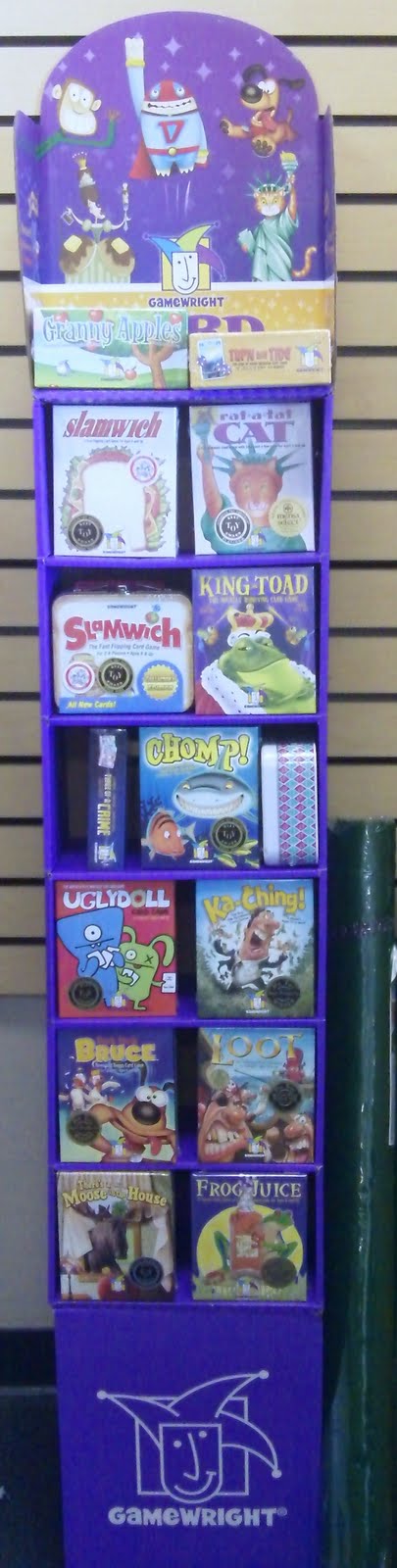
The game trade does a horrible job with kids games. It's mostly a niche filled by toy companies who sell direct. We recently opened a Habba account to get at their excellent games, and we're planning to expand other lines. Yesterday we brought in a Gamewright rack with a bunch of additional card games. These are popular, inexpensive. mainstream card games that many of our parents like.


Finally, we've paid attention to our customers requesting dice games. We've brought in a variety of dice games and have stocked our dice cups deeper. Not shown here are other classic games, including additional checkers and chess sets, bridge cards and bridge score pads. We also found a source for Pressman games, and brought in the first half of our Pressman order, including Tri-Ominoes, Rummikub, Mastermind, branded games like Jeopardy and Wheel of Fortune and their line of domino sets. Hey, grandma gets to play games too.


So what about the hobbyist? We're in this wonderful position of having enough inventory to satisfy most needs, and solid inventory systems in place to cycle out older inventory so we always bring in the new releases. Our strong 40K sales have strained the budget of late, but overall sales are strong enough to compensate. Besides 40K, we've been able to expand in other areas too, such as Malifaux, Pathfinder and a broader selection of card sleeves. Also, most game sales are fairly flat, except board games and CCGs. Whenever you're cursing CCG players (we all do at times), I'll just point out that CCG sales have kept the store in the black over the last year.

Inventory is a zero sum game. Something had to go for all this new stuff to arrive. Toys have fueled a lot of this transition, as we move far, far away from our initial diversification attempts. I've even accepted that a lot of good selling toys just don't meet our objectives, so they must go too. A lot of miniature games have hit the discount bin as well, such as all but our core Lord of the Rings sets, initially ramped up for the War of the Rings release, Firestorm Armada, Infinity and most of our "indie" miniature section. The indie minis were a good idea in the old economy, but failed miserably in the penny pinching new economy. Collectible miniatures are officially dead as well, with the last Star Wars minis release behind us (SW is on clearance at 40% off) and all the D&D minis moving to semi-collectible. Our minis rack is slated for removal soon.

Tuesday, May 4, 2010

About Me

I've always wanted to be behind the scenes, rather than out in front of my business, but that's just not how it works, at least not if you want to be successful. There's a certain level of small business self-promotion that's required, and I have to admit it often makes me uncomfortable. Nevertheless, I must own this circus that I'm running and that includes standing in front of the big tent and inviting people to behold the wonders within. Step right up!

So here's a brief background, suitable for my future website upgrade:

Gary Ray is owner of Black Diamond Games in Concord, California, the premiere game store in Contra Costa County celebrating its seventh year. He has an undergrad degree from San Diego State University in Asian Studies and a MA with honors from Graduate Theological Union in Berkeley. Studying classical Tibetan and writing his honors thesis, Tendai Influences on Dōgen's Concepts of Enlightenment, qualified Gary to bus tables in a sushi restaurant. Luckily he had other interests.
 
Gary was interested in computers, especially connecting American Buddhists electronically in the pre-web era. He was co-founder of Tiger Team Buddhist Online Service and editor of CyberSangha magazine. This eventually resulted in meaningful IT employment around the time of the dot-com boom. He became very good at spending other peoples money, mastering terms like "burn rate" and observing esoteric business practices, like selling products at a loss in hopes of making it up in volume. Anyone who could combine a noun and a verb into a company name was a genius during these times. These practices are not generally recommended when spending your own money.

While working in IT, Gary enjoyed running elaborate Dungeons & Dragons games, usually requiring obscure gaming supplies that Bay Area game stores neither stocked nor could successfully special order due to their general lack of competence. This got him thinking, and combined with a general hatred of the IT field, one which most of his IT peers shared, he took up a vow of poverty in hopes of running a better game store. Astonishingly, it worked.

Since starting the store, Gary has dabbled in Euro board games, enjoys playing Warhammer 40K (Imperial Guard Tallarns FTW), and of course, engages in his true gaming love, Dungeons & Dragons -- currently Pathfinder. He played Magic: The Gathering, back in the day and has dabbled in other RPGs, but it's that love of D&D and those esoteric accessories that excite him.

Gary is also married with a six your old son named Rocco who's obsessed with Hot Wheels and time travel.  When not working, painting miniatures, planning a D&D game, or writing in the third person, his priority is family time.