Tuesday, October 10, 2023

Magic: The Supply Problem

How did we get to such a severely devalued situation with Magic the Gathering? There are a number of factors. I think we had a unique set of circumstances, a perfect storm of product expansion, COVID fear leading to a flight to quality, and an inability to calibrate supply and demand because of all the noise. It was exacerbated by a publisher who not only pumped out a tremendous amount of product SKUs, but likewise dumped it alongside frantic retailers. It is a closed loop system, unable to self correct, because of a publisher likely grappling with the same issues. Let's look at each issue individually:
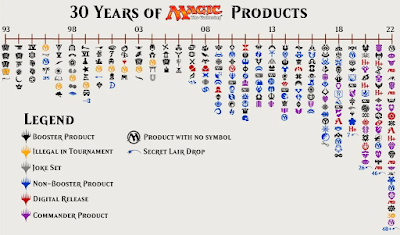

  1. Massive Product Expansion. By looking at the chart above, this seems to have started well before 2020, when COVID made Magic a safe harbor. We've seen a huge number of sets, with an expansion of formats and specialty offerings. The end result, I think most retailers would agree, is overall higher sales across many more products. The problem came from how we ordered those sets.

  • Past Performance is Not Indicative of Future Results. Retailers ordered their typical amount of product based on very steady past sales. However, what we discovered were sales were split over a variety of products, with overall higher sales, while leaving us with overstock of nearly everything, as the average SKU underperformed. We were in new territory. We figured this would all work out eventually, so it was allowed to linger on.
  • COVID Money. In 2020 and 2021, many of us were in pretty desperate straights. We had restrictions on customers coming into the store, no or reduced organized play, and there were few sure things to pay the rent. Magic was pretty sure. In 2020, with my store closed, I made personal deliveries of Magic product to my customers homes. It was astounding they were willing to work with us and I'm grateful. Because Magic was a safe harbor, it was easy to not only spend money on it, but to buy deep. 
  • Safe Harbor. Nobody ever lost money on buying too much Magic, if you waited long enough. This is similar to the IT phrase, nobody ever gets fired for buying IBM. In troubled times, when things are chaotic, there are some safe bets out there, and Magic was a pretty safe bet. If you had the aforementioned COVID money, you could simply sit on any slow moving inventory and consider it a retirement account. Unfortunately, this situation continued well past 2020. I think it culminated last month with the near instant price collapse of Commander Masters. COVID money is mostly gone, both for retailers and consumers. Magic is no longer a safe harbor, but more of a boat anchor.
  • Variety Impeded Purchase Reductions. When Magic is a huge percentage of your sales, perhaps the majority, a reduction in Magic sales is a big reduction in overall store sales. Retailers have been attempting to fine tune purchases, rather than just stop them, because as you can see from my chart, overall sales are up. If you could predict the demand for each item, you could crack the code! Unfortunately, there was too much noise in the data, too many Magic releases of different styles and formats to get a foothold on purchasing. You could reduce your orders multiple times and still lose as the bottom fell out. Those years of steady growth had a very simple product makeup, and we're now seeing a lot of expensive experimentaiton.
  • Wizards of the Coast Was/Is Dumping. What hurt sales and the ability to get rid of overstock was WOTC on Amazon. The Amazon price becomes a benchmark. Some customers see it as a de facto MSRP, since it's the only place that has Wizards of the Coast is listed as the seller. Yesterday they were dumping Ravnica Remastered at below cost on Amazon, a set that releases in January that retailers haven't even been solicited on! There will be some who will argue that it's not WOTC on Amazon, it's Amazon itself, but it's happening on Wizards of the Coast's watch. They are responsible. It has their signature on it. When the publisher is devaluing product, selling at retailer costs, there is nowhere for the price to go but down. It's why the market price of so many products online are at below cost. In the race to the bottom, Wizard's of the Coast is the 500 pound gorilla shoving everyone out of the way to the finish line.
So what's the solution? Retailers will continue to attempt to fine tune, to order less. Wizards of the Coast is dumping product before its release, which is perhaps a sign that we are beyond pumping the brakes. I'm at the stage of just slamming on the brake pedal and letting the car go where it must. My holiday profits may be about weathering a much reduced Magic sales environment. If this were the stock market, I think my advice would be to sit on the sidelines with your cash in the short run, focus on your growing non Magic investments in the long run. 

Monday, October 9, 2023

Magic Mystery: The Elusive ROI

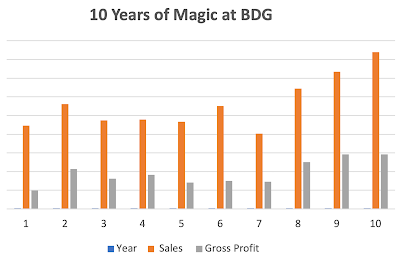
There is a mystery. I wrote yesterday about the disaster that is Magic the Gathering, however that is half the story. The other half of the story is the success of the product SKU expansion. From a sales perspective, this should be hugely successful, and the numbers say it is. Overall sales of sealed product, according to most of my peers, and Wizards of the Coast, is up. Looking at my chart below, on the surface, there's not much to complain about.

Looking at the chart, you'll see some pretty boring Magic years, a dip in 2020 because of a COVID shutdown and then 2021-2023. 2021-2023 represents the new era of Magic, strategy of expanding SKUs. We see rapidly rising sales and gross profits (although that's faltering a bit). Looking at this chart, we appear to have a win! 

The Mystery: Many stores have a similar chart. However, this is only half the story. This is a report of what sold, but it is not a report of what didn't sell. So basically, if you had perfect information, and knew precisely what to buy, there would be no complaints, no overstock, no unsellable product. The chart would tell the whole story. Data like this is all that Wizards of the Coast has from stores. 

The metric that best tells me how I'm doing with money I'm investing in product is called Gross Margin Return on Investment. GMROI for Magic is pretty bad for me. My GMROI is 1.6, which means for every dollar I spent on Magic, I made $1.61 back, which is not very good. Last year Magic was at 1.2! I've been grappling with this for a while now. 

A good GMROI is about 3.2 and my overall store is at 2.9 right now, no doubt pulled down by the low GMROI of my top brand. My store is fine, with Magic at around 30% of sales, but imagine if Magic is most of your sales. You might be looking for a job, while sitting on a stockpile of what would have been your retirement just five years ago. With the exception of the legendary Fallen Empires, nobody ever lost money with too much Magic, until now (Fallen Empires is at $550 a box, btw).

As a side note, My Lorcana GMROI, a game in which I possess not a single piece of stock, is the best in the entire store at 323. It would be nice if these two companies could find some middle ground when it comes to production.

The Solution: With a low GMROI for Magic, and high sales, you have large sales numbers, but you need all that money to pay the inventory bills for the (near worthless) product you have in the back. Rather than just complain about this, you can see there's an opportunity in the numbers. If retailers can crack the code of buying the correct amount of inventory, we'll see the same sales levels but better GMROI numbers. That means more profit, rather than great sales, but layoffs. I can imagine where bean counters at WOTC might not understand this, because they only have the sales data. They can't see the overstock as they don't collect that data from stores.

The solution is obvious, you order the correct amount of product. Easier said than done. The problem is it's a moving target and the sales dynamics have changed. I can order less, but customers are becoming shy at around the same time. Prices are falling instantaneously, making them unwilling to take a chance. Devalued products don't sell at near any price, at least in brick and mortar, which is why they don't show up in reports as reduced profits. Usually you can see a clearance sale in the data, but there's no data if you can't clearance anything. 

It would be best if Wizards of the Coast took the initiative and did this themselves by printing less product, which they may have done with the upcoming Doctor Who set. Magic is lucrative and it's tough for many small stores, relying on a large amount of their income from Magic, to take the steps to forego potential income for the sake of a stable supply. WOTC should do it for us, sad to say. But they're no white knight in this battle, having been guilty of dumping themselves. Solve this mystery and we'll have a historical blip to look back on as this strategy of expanded SKUs pays off into the future. 

Sunday, October 8, 2023

Magic Price Collapse

I started my store in 2004 with the whispered stories of Fallen Empires from a decade before. Distributors, stores and even Wizards of the Coast took a big hit when in 1994, after a series of allocated Magic releases, suddenly everyone got everything all at once. The set was over ordered, over produced, and the storage costs alone threatened WOTC. Everyone vowed not to make that mistake again. According to MTGWiki:

After Fallen Empires, WotC would carefully decide how much of a particular product to print. It was a total swing of the pendulum. A formula was established by the Sales team at Wizards, and how much new product the distributors received was based on how they scored on the profile. How much the local retailer got was in turn determined by the distributors, each of whom had different ways of deciding how much of their allocation would go to the retailers. 

The last several years has been quite the Magic ride. It is clear Wizards of the Coast is not putting any restraints on their print runs. Imagine Fallen Empires, as a three year period of releases, culminating (so far) in Commander Masters. Commander Masters saw its value plummet days after release. I've never seen a Magic product sell alright on a release weekend and simply stop selling entirely on the following Monday. The market price dropped to below cost that quickly. 

Whereas I couldn't understand my income statement back when Pokemon was selling over keystone, I couldn't understand my income statement in September because I had become a discount seller, selling Commander Masters slightly over cost. Sales were wonderful, but where was the money? Both of these were new experiences. 

I do expect something to change soon, for no other reason than I can't afford to keep doing this; nobody can. A sell out of future Magic sets, much like how we treat Yugioh, would be more welcome than extra stock. The Yugioh strategy is to print a set, distributors take pre orders, stores get in their boxes, and within a short period, it is hopefully gone everywhere. Nobody wants to be caught holding. 

In the past, Konami would reprint every high value card into future products, much as Wizards of the Coast is doing with Magic, killing any secondary market opportunities. This is the Yugification of Magic. The secondary market, the activity of selling singles, is the "collectible" in Collectible Card Game. That's not my market, but I absolutely benefit from it when I sell sealed product. I'm punished when that market fails.

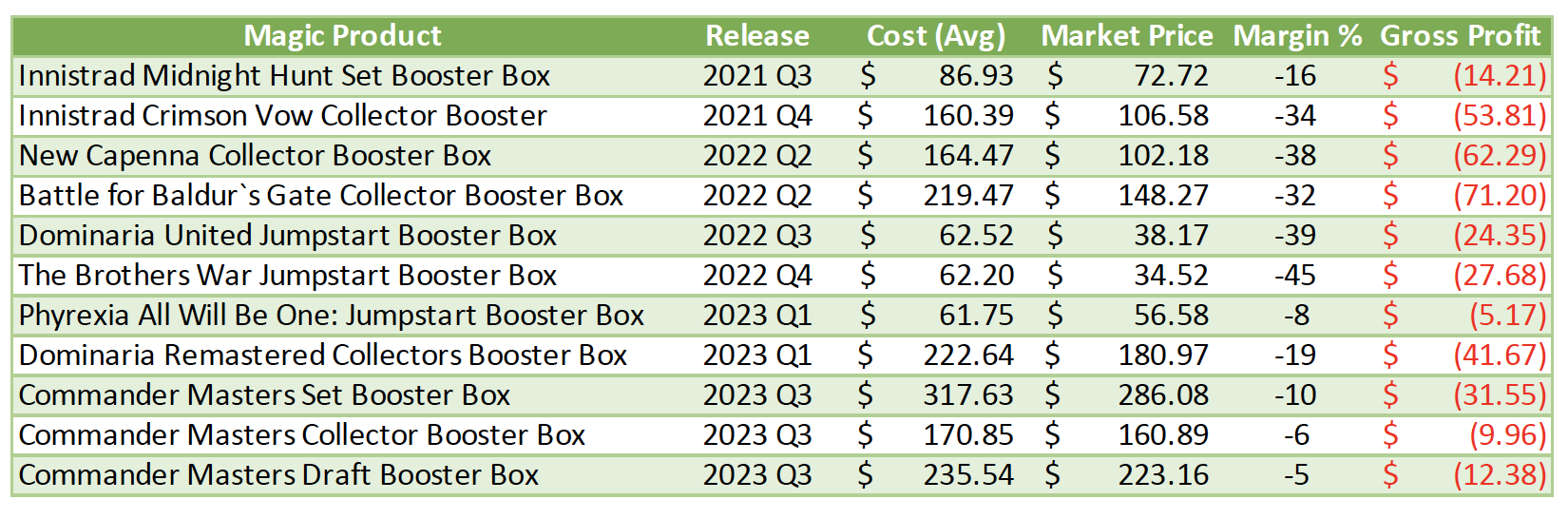
Here is a visual understanding of this problem. Below is a table showing the Magic products I have on clearance in my online store. These are all from the last three years. The chart uses TCGPlayer market prices, essentially the stock market for trading cards. This is an idiosyncratic list, but I think it's fairly representative of the market. Nobody will buy this product at just about any price. I have $8K of dead Magic inventory, and another $12K of Commander Masters, which hasn't been declared dead yet, but might as well be, as I attempt to sell it at a dismal 16% margin (well above market prices). At the beginning of the year I had a similar value of dead Magic, so this has not improved for me.

Click image to Embiggen

There is speculation Wizards of the Coast is attempting to boost revenue, possibly in hopes of selling the company. There appear to be signs of tying up loose ends. I hope buyers realize the damage done to the brand by this pump and dump strategy. When you overprint a collectible product, you don't just kill the value of that product, you undermine confidence in the market as a whole, collectible cards going back decades. Which valuable vintage card will be reprinted next? Where will the hit come with the next press release? It's why we're seeing long time sellers of singles, multi million dollar companies, exit the Magic singles market. The only one winning in this game is WOTC short term profits. The brand may never recover. I wouldn't want to buy into that mess. In fact, I plan to buy a lot less. The empire may be falling.

Saturday, October 7, 2023

Anatomy of a Time Traveler

They say a store makes money in the buying, but I think you can also say a store loses money in the restock. I run a front list driven retail store, dependent on new releases. However, I've never turned down a reasonable restock. The key to a successful restock is understanding the product. 

You cannot just rely on performance metrics, which is why buying is not an easy job to delegate. Buying requires understanding the meta of the store, the game, and the customer. There is a story behind every product and you either know it, or you don't. The more you know, the better your buying performance.

Let's take a look at a single product. It happened to sell this morning, so it's on my mind. Today we'll examine the Necron Chronomancer.

The Product: Immediately, you may notice it is a blister from Games Workshop. It's a special character or command option and it will likely be a slow seller. That's all I really know about the game meta. It is likely to go out of print quicker than a box set, so if I want to have this for the holidays, I may want to buy more than one.

How is it performing? This is the first step in deciding if I'll bring in another model. However, it is not always simple. Looking at the Sales History table below, I've sold one in the last month, and five in the last year. I see that I've sold 14 in its history, which tells me it's not a new model from the recent release. It's a steady seller. 

The Game: One thing I might do is look back at the history. I may have sold five in the last year, but did I sell all five, say seven months ago? Could there have been a spike in demand hiding in the numbers? If it were later in the new Necron Codex release, that may be the case. I may have a product where the demand was satisfied early on and now this was the last one, rather than the latest one to sell. The numbers can lie.

What do these numbers even mean? I'm looking at turn rates on individual items like this. In this case it has a turn rate of five in a year, which may or may not be distributed throughout the year, as mentioned. My 40K department has an average turn rate of around four, which means this model is well within those performance metrics. The Necron Chronomancer appears to be solid.

There are other inventory considerations as well. For example, there are many slow selling, underperforming Games Workshop items that are considered part of their core offering. I must carry these, if I want to engage in various promotion programs. I'll have a notation on the product code to let me know not to make the smart inventory choice, but rather nod to the marketing department. It all gets lost in the sauce, to use a Miami Vice line.

There are products that are often part of a collection or set that I want to promote. The Necron codex was recently released, and for a while at least, I want to have every Necron item available. Unfortunately, about half are out of stock, but I'll keep trying. If the turn rate on the Chronomancer were really low, like perhaps one, I might decide this was my opportunity to finally move it. I also might second guess myself and figure the Chronomancer might be good in the new codex. Since it took several months for this to sell after the codex was released, I'll assume it's about the same. I might even ask somebody.

The Store: How is my 40K community? Is it on the upswing or downswing? Our coordinator coordinates for a couple different stores, a relic from the COVID times of attempting to get events restarted. I consider that shaky. Do they have events scheduled for the future? Is the community drifting towards other games? How many starter sets are we selling (not enough), which often determines if we have new entries into the hobby or if I'm selling to the same people. 

With a Necron model like this, it shows long term success over time, but there are often times where we see spikes in a new model, then nothing. That community got the model they wanted and there are no new people coming in to buy it afterwards. This happens a lot with miniature games. It's where all our Fantasy Flight miniatures games are. We sell a ton of new releases, while the middle period releases are dead, and the starters barely hang on. Veterans will buy out the new releases, but you often need new players for your restocks.

How do you teach this? That's my big concern with anything I do. How do I transmit my considerations to a new buyer? Do my fuzzy, subjective criteria even matter? I believe they do. When I first learned performance metrics, I broke a lot of stuff. It turns out you need a lot of stupid inventory to support the smart inventory. But how do you know which is which? It turns out there's a lot of art to the science.

We had a manager who was exasperated at my 40K buys, thinking I was clearly incompetent as a buyer. I let her take a theoretical stab at the new release and she was picking inventory no better than chance. Customers were not making logical choices! My performance with the line is probably just a little bit better. There are just too many competing factors, including the company itself trying to outsell me. In these cases, it's better to hope for a sell out than a long tail.

It would be easy to error on the side of not buying. At the end of the month, you're rewarded by not doing your job with a pile of money. You can do that once or twice a year, if you need to, but there's a cost. My first attempt at delegating buying, during a ten week trip, resulted in needing to talk with the manager. "You don't understand, you must buy. The amount you must buy is your Open to Buy number. Spend all those dollars." 

Finding things to buy on a daily basis is really easy. The hardest work comes from finding new lines, new companies, new departments to expand into. I could very easily continue to buy deeper and broader hobby games, and my systems says I should, but I do believe my market is being served in that arena as best as I can fathom. I get better results nowadays with hobby adjacent products, like stuffies, pins, magnets, and yes, toys. All of these new items must be carved from the existing budget. All of these items are the first to die in a recession.

So back to our time traveler. Maybe I decide to only stock Necron Chronomancer one deep, providing me $22 (the cost) to buy a couple stuffies. Can I sell these stuffies five times in a year, like those Necron dollars? Looking at my reporting, my Toy department turns at 5.42, so I think the answer is yes. Then again, it often takes me a month or longer to get a solid Games Workshop restock. I might need what we call "safety stock" to weather the typical Games Workshop outage. Perhaps two on the shelf would be safer. I just don't know. Neither does anyone else.

Wednesday, September 27, 2023

Thoughts on Selling Your Business

I was talking with friends about selling my business. I'm not looking to do this, to be clear, although there's always a price. There are a couple of scenarios. Let's peer down this rabbit hole (again):

My Business Has No Value. Not my scenario, but if you have an unprofitable business, you're in the category of needing a liquidation value. Some people don't believe in the myth of profitable retail and think all hobby game stores are in the liquidation category. The liquidation value of a business is pennies on the dollar. Ten cents on the dollar for inventory, furniture, fixture and equipment (IFFE) is about right. 

Most (former) store owners will dig in, keep their inventory and sell it online out of their garages for years into the future, in hopes of getting 20 cents on the dollar. They have never been good at figuring out the value of their time. I once bought a friends store for 20 cents on the dollar in consignment, and it nearly broke me. I wouldn't have done it, except I picked out his inventory.

Your Business Has Some Value. It's a little bit profitable. Let's look at sale multiples. Do 3-5x your net profits exceed your liquidation value? Let's say you have $10K a year in net profit. You have $50K in IFFE. Liquidation will get you $5K, $10K if you don't value your time. You could argue a 3-5 multiple of your $10K net for $30-50K. You can see here that being just a little bit profitable will vastly increase your payout. Even at that highest multiple though, you're just emerging barely alive. 

This scenario assumes your business is worth keeping rather than liquidating. Buying a business in this fashion is deciding, as a new buyer, that you want to personally run this business. This kind of business is a "buy a job." It has little potential. It's a place to park your life or maybe the life of a child who needs to find their place in the world. The new owner would expect to take your current salary, plus that $10K a year. Living the dream.

Your Business Has A LOT of Value. You're living off it. It's your retirement plan. You're in the groove and can do it until you go blind or die quietly in your bed. This is my scenario (although not my numbers). Let's say you do $100K a year in profit. You have $500K in IFFE. Liquidation might get you $50K, which is ridiculous in this scenario. However, treating it like a real business, you might attempt to get a multiple of your net profits. A 3-5 multiple of your net is $300-500K. However, we have a couple problems.

First, finding someone to pay you half a million dollars for your hobby game store is going to be difficult. It would be nice, but it would be unprecedented for a store that's probably doing (let's say a 5% net profit), $2 million dollars a year in gross sales. It's not unreasonable, just unlikely. I do think the world is changing and the odds are increasing.

Second, $500K really isn't enough money. If you're enjoying your perpetual $100K a year in profit, $500K isn't going to provide you that steady income you need in perpetuity. Let's assume you can get a long term return of 5% on your new $500K nest egg. That's only providing you $25K a year in income, a far cry from your current $100K. 

The amount of money you actually need to replace your $100K annual income is a payout of $2,000,000. I have to say a one year payout of your gross is a multiple that's thrown around, but it's way more than five years of your net. You better have a turn key operation and that key better be made of unobtainium. You aren't likely to find such a generous buyer. So clearly, a profitable business, providing you the money you need, is never going to be worth selling. However...

You Need Out. Nothing lasts forever. You've simply had enough and want to do the next thing. Or your health is failing. You are ready to retire. You have made some missteps. You need to sell it. In my case, I will eventually have social security income, retirement savings, and probably a small inheritance. I might decide I have enough and don't mind my $25K extra a year in exchange for my time back. You can also see that putting more money into this monster is probably the wrong choice when there are other retirement investments available.

There may come a time when I'm ready, but I might not be prepared. In fact, the longer I wait, the less likely I'll be prepared. This is very dangerous, because it not only takes time to sell a business, the reasons you might want to sell it, such as the business not doing so great because of your distractions, can greatly impact that business value. Drop down from highly profitable to break even and our pay day becomes a fire sale. 

My impression is that after decades of fostering the business, you have to get out while on top, but also at a time of your liking. You have to sell the cash cow while it's still in good health, not when it's forgotten out in the pasture. When you have to sell it, is when you look around at what's possible. A $500K graduated inventory reduction sale might be the payday you're looking for. 

You might start courting potential buyers years in advance. You may decide to hand it to your heir, who may require years of training and experience. At the moment I have a key man insurance policy that will give those around me a fighting chance at making the business work without me. So if you've got this profitable business, you're walking a knife edge here. Nobody can possibly give you what it's worth. Finding a buyer who will pay you less than it's worth is a time consuming challenge that seems foolish considering your current circumstances.

As a small business owner, it's just another thing you need to think about.

Saturday, September 23, 2023

Why Turn Rates Lie (Tradecraft)

A friend noticed my comment yesterday about how my CCG turn rates went from 18 to 4, over the last several years. He lamented that must have been difficult to deal with. Yes and no. The problem with talking about turn rates is in the name, it is a measure of something happening. But what's happening?

Turn rates are the number of times in a year you turn over, or sell through your inventory. So we're dealing with two numbers here. We have the inventory value and the sales velocity. It's fine if your inventory is stable, but what happens when your inventory is expanding or shrinking? 

My inventory value of CCGs in 2023 is roughly three times what it was in 2020 (my sales are not three times higher, and we'll get into that). So maybe my 2023 turns should be a COVID adjusted 6, instead of 4 (18 divided by three). A turn rate is a nice data point, something to keep in mind, one variable among several. It can be deceptive though. 

I should mention we sell almost twice as much CCG product in 2023 than in 2020, which has transformed the store and my life. But as I mentioned we have three times the inventory, which is way too much.

Rather than look at turn rates, a more accurate view of what's going on is Gross Margin Return on Investment. GMROI was something I would rarely calculate before my new POS system, because it was cumbersome. However, my new reporting package crunches those numbers for me, without having to ask. GMROI says that for every dollar you spent, you got X dollars in return. 

The first time I crunched the GMROI numbers myself, I realized I was getting a 65 cent return on every dollar I spent on chess sets. That was a much clearer reason to dump that category from my store than say, a turn rate of 1.5. I now carry just a handful of chess sets. GMROI is a much clearer lost opportunity. 

My overall store GMROI is 2.92. This is alright, but not great. A good GMROI, according to articles I've found (because we don't talk about this number in the game trade) is 3.2 or higher. I don't know of a game trade specific value. 2.92 means we have room for improvement, and the biggest area for room is ... you guessed it, CCGs. 

My GMROI score for CCGs is a sad 2.17. Basically, all the same categories with poor margin (calculated in the last post) showed up with below average GMROI scores. However, CCGs is by far, the worst offender. Like a lot of stores (and distributors), I'm sitting on a ton of CCG product from the last three years. 

Because we're all in the same boat, with the same CCG product that needs to be dumped, there is little opportunity to quickly liquidate that product. It is often sold well below cost online. I'm primarily talking about Magic: The Gathering. The game has seen a shift in strategy, production volume, and product variety. Many stores are trying to unwind this experiment. 

What this means for a purchasing budget, meaning how stores spend, how distributors spend, and what happens to people trying to sell to stores and distributors games, is a slowdown. We will all slowly unwind this product, because there is no quick selling of a universally dead product, other than a dumpster fire. It is broadly recognized as trash (even when it's objectively good). 

Those of us who can't unwind their inventory might fail, and I'm certain some already have. It's one thing to personally over order and make a mistake, but when an industry over orders and makes a mistake, the effects will ripple outwards and it will gum up the works. I will buy less, distribution will buy less, and publishers of games, who having nothing to do with Magic: The Gathering, will feel the effect as orders decline. Even if we did get rid of this stuff, we have been left a little impoverished and gun shy as a result. And that's how the post COVID boom ended. 

Friday, September 22, 2023

Margins (Tradecraft)

Your sales are strong, but your profits aren't where you want them. Margin may be to blame. Strong POS reporting can help you determine weaknesses. Likewise, you may find yourself with a perplexing abundance of cash, and margin may get the nod for that success, once you identify it. I'm questioning margin this morning, so where do I look?


The first thing is trends. My margin this month is no different than my three year average. I'm probably fine, or if I'm not fine, I'm no worse than average. If you don't have a fancy reporting package, you might have to crunch some numbers to get this data. I have this calculated on my Open to Buy spreadsheet as well.

Next is individual departments. I might be hitting my average when it comes to margin, but I feel like some of my departments are under performing. I feel a disturbance in The Force. Let's take a look:

In this case I've massaged my numbers and added some color. The green departments are doing pretty well, above average of around a 45% gross margin. Some of this is a lie. For example, my puzzles with a 51% gross margin don't include shipping charges, which are often part of purchasing. I offset those when possible. Dice include non inventoried loose dice with no cost associated with them, which can boost the reported margin. Statistics are lies, but if you know which ones you can and can't trust, they're still useful.

Of all the colors, the blue departments are most irksome. CCG Supplies should generally be a high margin department. However, we've had a bit of a purge, and with a clearance sale comes a hit to margin. Board games are in the same category, a perpetual cavalcade of clearance. The question there is should I order fewer board games? I decided several months ago I should be more cautious, but that's not reflected in the numbers yet. 

I have a strong FOMO instinct when it comes to board games, mostly because I'm not a board gamer and don't want to miss a chance. We sell 700 board games and none sell more than 100 copies in a year. I have a strong Bilbo Baggins feel about my board game.


Finally we have the red departments, the problem children. CCGs are commodity priced, so I see their low margin as systemic, part of the deal. I don't sell singles or lump "events" into this category, which could raise margins. This is systemic for many stores, part of their deal. I was also hurt by selling Commander Masters at market prices, which is pretty much a fire sale. CCG margin has held up pretty well, regardless, if you can accept those numbers. A diversified store is able to sell CCGs at a 35% margin all day long, but a card shop? You better have volume and low overhead.

Miniature Games are a bit vexing, as it feels like sales are primarily comprised of new releases and clearance items. Again, I've decided I should slow down on ordering some of these games, but that's not reflected in the numbers yet. We lack enough new players to keep these lines strong; they are somewhat static. We can't give away Games Workshop rulebooks. Despite a new 40K edition, there does not seem to be a lot of energy in the category. It's a tough category to crack with an uncertain economy, but that's probably just an excuse.

RPG miniatures have also seen a deep clearance of dead wood. I've dumped a huge amount of WizKids dead miniatures, while at the same time bringing in a ton of back orders that finally came back into production. The restocks aren't reflected in the numbers, but they offset the dump of dead plastic in sales.

To summarize, we want explanations, not excuses. We want action items, otherwise we're just wasting our time. What we don't want to see are perpetual low margin categories, if it can be avoided. What are some of my action items?

  • Price Increases: Boost prices on snacks slightly to return to higher margins (50% at least)
  • Diversification: Crack low margin CCG titles for singles. Commander Masters, for example
  • Fine Tune Ordering: Order about 15-20% fewer board games, maybe when you're thinking about ordering 6, you order 5. The biggest change would be to order none rather than speculate.
  • Stop Ordering Multipacks: Fine tune RPG Miniature ordering based on performance metrics, and not a sleeve of 6 of everything. I order a six pack of paints from one company that doesn't require me to, because Games Workshop trained me.
Low margin is a buying problem. You primarily have a low margin because you're an inattentive buyer (blaming myself here). Sure, marketing could be improved. You could demo board games better to not have to clearance them, but low margin generally comes from blowing out dead product. You have dead product, because you didn't forecast demand properly. Be better at forecasting. Build a more robust supply chain so you can re-embrace just-in-time ordering. Get your sales team to promote fewer titles at higher volume, rather than a shotgun approach. Easier said than done!

Gross margin is also just one metric. If I look at a seemingly healthy department, like puzzles, what do I really see in sales? My staff despise puzzles, and they've been a thorn in my side, but they've been managed since COVID and have a turn rate of four for the year, which is really good. My 3.14 GMROI is slightly above average too. If puzzles were sitting on the shelf at full margin with a turn rate of one or two, that would be a problem. Margin won't tell you about those shortcomings.


Turn Rate

GMROI

Then again, my CCG turn rate is currently four, but before COVID it was 18. Somewhere between 4 and 18 would be better. You have to have a grasp on what's normal and what you're trying to accomplish. Four is actually up from two at the beginning of the year, so I'm not complaining too loudly.

Finally, this is dynamic. I can't think of a time where all departments were firing at 100%. There is always a problem child. Try to not make it the same kid every time.