Wizards of the Coast made the rare disclosure that they sold $200 million in Magic last year. That's twice their revenue from 2008 and also explains a lot of our success recently.
That $200 million dollar amount is interesting. It's roughly the amount Games Workshop took in for 2011. So all of GW, Fantasy, 40K, Lord of the Rings and their nifty paint and tools, equals one brand: Magic.
As a store owner, I can't help think of the differences between these two. The small amount of space Magic takes up compared to the acres for Games Workshop. The bulky, nearly immovable terrain tables and cabinets and shelves of terrain needed for miniature games compared to the folding tables for Magic. Magic feels ethereal, wistful, likely to flit off at any moment like a fairy, while miniature gaming feels stolid, stable, and unlikely to go anywhere soon.
Sounds a lot like our customer base too. The problem with Magic is it remains a commodity, perpetually available at deep discounts (an area where charging sales tax kills us), while miniature gaming tends to develop a more stable community. In an experiment a couple weeks ago, we sold our Magic Dark Ascension cases (not boxes, cases) at a price approaching Internet discounters. The result was our best gross sales day ever, and a struggle for more supply, as quite a few people supported us with case purchases rather than buy online. I would like to call the Internet the "shadow" market, but clearly, when it comes to Magic case buying, we're the shadow and they're the market. We're working to build our Magic community, but there's always that shadow over our efforts.
Like Wizards of the Coast, we saw our sales rise dramatically over the past three years because of Magic, but the rise is scary because of where it's coming from. If we saw a rise in 40K, we would be more content and willing to invest more into that community. However, a rise in commodity games, CCGs, is just bonus. It's shifting sands. Sure, there's community, but the money feels like some extra cash we shaved from the Internet sellers. So yes, we plan to expand our store and actually cater to the RPG community even further, but it's with an understanding that we're one bum set of Magic (and Yugioh) away from seeing it all fall apart. We're in a perpetual three month wait and see cycle.
Anyway, I was going to write a post on looking at the positive, at finding why stores succeed instead of giving excuses for why they fail. The moral of this story is diversification. Enjoy the boom, expect the bust, diversify into other games. The biggest threat of a boom, is neglecting your other customers or other departments. GW can tell you stories about how their sales people's skills atrophied during the Lord of the Rings miniatures boom when the movies were out. That's a real danger. Or maybe you start doing the math and realize that D&D makes about 10% of what Magic does, so you start wondering how much more money you could make if you replaced those crusty book shelves with more gaming tables for the Magic crowd. Money warps your brain. Don't let that happen.
Finally, some perspective. Hasbro is publicly traded, so we can do more math to determine that Magic is around 5% of their revenue. It's money, but it's no big deal. We don't know the numbers for Dungeons & Dragons, but I assure you, it's likely to be a rounding error when you dump it into the Hasbro spreadsheet. If they do ten times more Magic than D&D, like we do, then D&D would be .5% of their revenue. So if Hasbro is paying any attention at all to that brand, they're looking at how it can be something that it's not now, like a video game franchise. The danger from Hasbro, therefore, is not monkeying with the brand, it's losing it in the math.
Monday, February 13, 2012
Thursday, January 26, 2012
Shrink Wrap
When I would shop at game stores before I had a store, one thing I swore I would never do is shrink wrap books. How can I possibly tell if I want a book if I can't see it? Most of the "shock and awe" stores, the ones with tons of inventory that seem more like time capsules than businesses, tended to shrink wrap books. Often it was because they intended to carry that book until it sold or their store closed for good. However, it turns out most stores have a pretty good reason to shrink. It's one more store practice I probably owe someone an apology over.
What I discovered fairly soon after opening my store is that a lot of RPG books will bow and warp with the weather. Eventually you're left with a sad little book that nobody wants. That book, despite how good it was, would end up in the clearance section, and no store owner wants to re-order something they just clearanced.
This is also a reason why game store owners like me prefer hard cover books (unless those warp -- AKA Mongoose). I'm often fairly oblivious to price, so whether it's a $20 softcover or a $35 hardcover matters little to me. There's even a part of my brain that would rather sell far fewer $41 Warhammer Fantasy hard covers than more $33 soft covers if I don't have to worry about them warping and becoming shelf worn.
So to fix the warpage problem, we shrink wrap the books. We've got a "machine" that does that. It's basically a roll of plastic on a roller, an arm that melts it, and a hair dryer to shrink it. Often we can shrink wrap a warped book and it will miraculously go back to normal within its sterile little plastic wrapper.
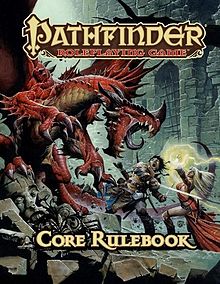
Most of the books we shrink wrap are for Pathfinder. Why? Paizo puts out a huge number of books. We carry all of them. Only 9 of those nearly 200 books are hard cover and most of those soft cover books sell, as a group, slower than your average hard cover, but fast enough that we very much want them on the shelf. This means they'll almost all eventually get shrink wrapped or suffer the scourge of warpage. The difference in the way we shrink and others shrink is that we wait until signs that a book is beginning to warp before jumping into action. A lot of softcover books sell fast enough that they don't need the shrink. If you're clever you can use that information to see our best sellers (reinforced by the fact you can read, and are therefore more likely to buy that book, since you can see it).
I go into all this because I want to dispel the thinking that we shrink wrap to prevent people from reading RPG books. In fact, it's pretty obvious to me that you're more likely to buy an RPG books if you can read it, especially a book from Paizo. While older D&D books tended to have a nugget you desperately wanted along with a bunch of schloch, the Paizo books tend to deliver the whole package. At least that's my personal opinion and my sales experience. So when we shrink wrap a book, it's done reluctantly, with the acknowledgement that this will hurt sales. It's not to keep it for posterity in the hopes it one day sells (like our shrinked AD&D books). It's also not that way to prevent shoplifting (like our shrinked Warhammer 40K books, which disappear into our Game Center). It's just one of those things we need to do to carry that line.
What I discovered fairly soon after opening my store is that a lot of RPG books will bow and warp with the weather. Eventually you're left with a sad little book that nobody wants. That book, despite how good it was, would end up in the clearance section, and no store owner wants to re-order something they just clearanced.
This is also a reason why game store owners like me prefer hard cover books (unless those warp -- AKA Mongoose). I'm often fairly oblivious to price, so whether it's a $20 softcover or a $35 hardcover matters little to me. There's even a part of my brain that would rather sell far fewer $41 Warhammer Fantasy hard covers than more $33 soft covers if I don't have to worry about them warping and becoming shelf worn.
So to fix the warpage problem, we shrink wrap the books. We've got a "machine" that does that. It's basically a roll of plastic on a roller, an arm that melts it, and a hair dryer to shrink it. Often we can shrink wrap a warped book and it will miraculously go back to normal within its sterile little plastic wrapper.Most of the books we shrink wrap are for Pathfinder. Why? Paizo puts out a huge number of books. We carry all of them. Only 9 of those nearly 200 books are hard cover and most of those soft cover books sell, as a group, slower than your average hard cover, but fast enough that we very much want them on the shelf. This means they'll almost all eventually get shrink wrapped or suffer the scourge of warpage. The difference in the way we shrink and others shrink is that we wait until signs that a book is beginning to warp before jumping into action. A lot of softcover books sell fast enough that they don't need the shrink. If you're clever you can use that information to see our best sellers (reinforced by the fact you can read, and are therefore more likely to buy that book, since you can see it).
I go into all this because I want to dispel the thinking that we shrink wrap to prevent people from reading RPG books. In fact, it's pretty obvious to me that you're more likely to buy an RPG books if you can read it, especially a book from Paizo. While older D&D books tended to have a nugget you desperately wanted along with a bunch of schloch, the Paizo books tend to deliver the whole package. At least that's my personal opinion and my sales experience. So when we shrink wrap a book, it's done reluctantly, with the acknowledgement that this will hurt sales. It's not to keep it for posterity in the hopes it one day sells (like our shrinked AD&D books). It's also not that way to prevent shoplifting (like our shrinked Warhammer 40K books, which disappear into our Game Center). It's just one of those things we need to do to carry that line.
Monday, January 9, 2012
We Need a Strong D&D
The cat is out of the bag. Wizards of the Coast is working on the 5th edition of Dungeons & Dragons. It looks to have all the right elements, like great designers (Cook, Merles, Cordell), an open play test they've promise to actually take into account (unlike 4E), and an all inclusive view of the game that's supposed to appeal to every player of every incarnation of D&D. It sounds too good to be true.
From a retailer perspective, a strong Dungeons & Dragons is critical to role-playing games, even if you don't like Dungeons & Dragons. D&D is the cornerstone of most store's role-playing department. Quite a few game stores have dropped role-playing games entirely with D&D flagging. The same would happen to us if we suddenly lost Warhammer 40K or Magic (board games are more diversified), and probably Pathfinder as our D&D stand-in. That's just unimaginable to me, like how I know I should drop chess sets, but I just can't bring myself to do it. How can you have a game store without chess sets? How can you not have Dungeons & Dragons?
Gaming segments live or die on their top dog, their market equivalent of Coke, or Hertz or whatever naturally dominant product drives sales. Without D&D, there are none of those "community service" level RPGs that we order 1-3 copies of each month, AKA everything not D&D, Pathfinder or Warhammer 40K RPG. You know what I would do if D&D (in my case Pathfinder) died? I would put in a coffee bar. That space would be dead to me. Also, despite what all the Amazon shoppers might think, the game store as community center is still thought to be the nexus of where new players meet the game for the first time. It's not your cousins basement or ENWorld.
But can't Pathfinder be the top dog? Maybe, if it has to. Honestly, I think Paizo does a much better job as an underdog. I think their guerrilla marketing and more adult oriented products play better as the snarky upstart. If D&D goes away, Pathfinder might have to take up that mantle, but I would rather they have a monstrously big D&D to thumb their noses at (in reality, the designers of both companies are friends and hang out together). It's much easier being an underdog. Americans love their underdogs.
The release of D&D 4 was the second biggest RPG release of the decade, second only to the release of D&D 3. Will we be as excited about D&D 5? Probably not. We don't know much about it yet, but it looks promising from what little we're hearing. D&D 4 came after a stellar, albeit somewhat flawed performance by D&D 3. D&D 5 will follow disappointment. D&D 5 will enter a marketplace dominated by a perfectly good version of D&D that they abandoned.
Success of 5 will ultimately depend a lot on whether the suits get hold of it. WOTC corporate tends to screw up D&D, from what we know. They did it with 4 and they did it with 3 right after release. If D&D 5, which is inclusive and community building, clever and wonderful, spanning the decades, and is full of passion, then great. But if D&D 5 is inclusive and community building, but is in reality a shameless attempt to leverage decades of intellectual property for cheap financial gain or drive people to a new video game, then, well, probably not so much. My guess is the release will be great, and then cheap financial gain will step in.
The pitfalls are likely going to be the company itself, which tends to consider creativity and passion for games to be an expendable resource that can be tapped at their convenience, focus grouped when they've lost their way, with the brand ridden hard when required and put away wet. Once the creatives do their job, they tend to be jetissoned, and the suits take over and we see a slew of ridiculous products that look brainstormed by the marketing department (another revolving door). I have a lot of faith in Cook and Mearls and Cordell, but I'm sure they get a little nervous during Christmas time when the pink slips blow around like New Years confetti. So you suits out there, don't screw this up.
From a retailer perspective, a strong Dungeons & Dragons is critical to role-playing games, even if you don't like Dungeons & Dragons. D&D is the cornerstone of most store's role-playing department. Quite a few game stores have dropped role-playing games entirely with D&D flagging. The same would happen to us if we suddenly lost Warhammer 40K or Magic (board games are more diversified), and probably Pathfinder as our D&D stand-in. That's just unimaginable to me, like how I know I should drop chess sets, but I just can't bring myself to do it. How can you have a game store without chess sets? How can you not have Dungeons & Dragons?
Gaming segments live or die on their top dog, their market equivalent of Coke, or Hertz or whatever naturally dominant product drives sales. Without D&D, there are none of those "community service" level RPGs that we order 1-3 copies of each month, AKA everything not D&D, Pathfinder or Warhammer 40K RPG. You know what I would do if D&D (in my case Pathfinder) died? I would put in a coffee bar. That space would be dead to me. Also, despite what all the Amazon shoppers might think, the game store as community center is still thought to be the nexus of where new players meet the game for the first time. It's not your cousins basement or ENWorld.
But can't Pathfinder be the top dog? Maybe, if it has to. Honestly, I think Paizo does a much better job as an underdog. I think their guerrilla marketing and more adult oriented products play better as the snarky upstart. If D&D goes away, Pathfinder might have to take up that mantle, but I would rather they have a monstrously big D&D to thumb their noses at (in reality, the designers of both companies are friends and hang out together). It's much easier being an underdog. Americans love their underdogs.
The release of D&D 4 was the second biggest RPG release of the decade, second only to the release of D&D 3. Will we be as excited about D&D 5? Probably not. We don't know much about it yet, but it looks promising from what little we're hearing. D&D 4 came after a stellar, albeit somewhat flawed performance by D&D 3. D&D 5 will follow disappointment. D&D 5 will enter a marketplace dominated by a perfectly good version of D&D that they abandoned.
Success of 5 will ultimately depend a lot on whether the suits get hold of it. WOTC corporate tends to screw up D&D, from what we know. They did it with 4 and they did it with 3 right after release. If D&D 5, which is inclusive and community building, clever and wonderful, spanning the decades, and is full of passion, then great. But if D&D 5 is inclusive and community building, but is in reality a shameless attempt to leverage decades of intellectual property for cheap financial gain or drive people to a new video game, then, well, probably not so much. My guess is the release will be great, and then cheap financial gain will step in.
The pitfalls are likely going to be the company itself, which tends to consider creativity and passion for games to be an expendable resource that can be tapped at their convenience, focus grouped when they've lost their way, with the brand ridden hard when required and put away wet. Once the creatives do their job, they tend to be jetissoned, and the suits take over and we see a slew of ridiculous products that look brainstormed by the marketing department (another revolving door). I have a lot of faith in Cook and Mearls and Cordell, but I'm sure they get a little nervous during Christmas time when the pink slips blow around like New Years confetti. So you suits out there, don't screw this up.
Wednesday, January 4, 2012
21 Posts You Probably Won't See
I was asked to write something for an industry newsletter, so it got me thinking about posting new stuff. Plus I had a wicked hot Vindaloo and couldn't sleep. Here are some posts I would enjoy writing, but probably shouldn't:
- How my retailer inspirations from when I started 7 years ago no longer run game stores. I wonder how many years they were in the business beyond 7 before exiting? Cautionary tales or natural progression? Who will take their place? Will anyone care?
- How our distributors give the thumbs up to brick and mortar retailers with one hand, while shipping large quantities of games to Amazon with their other. It's not hypocrisy, it's business.
- How some game stores use Amazon Prime as a supplier. Hey, it all comes from the same place, right? (as my grandfather would say when he mixed his peas and potatoes).
- Why Fantasy Flight Games is the new 500 pound gorilla in the game trade, but still, in many annoying ways, acts like a small company (because I don't know).
- Why my paperless office initiative failed, mostly because the paper was useless to begin with. A bucket for monsieur!
- My exit strategy from owning a game store (because I don't have one).
- My innovative new marketing plan for 2012 (see above).
- My deep fear that I'm running a model train shop. When you're the last man standing, you sometimes wonder if the other guys knew something you didn't.
- How the Games Workshop new emphasis on customer service training to boost flagging sales sounds a lot like the Best Buy emphasis on customer service training to boost flagging sales. I'll have to remember that one for when my sales are flagging. Also, they closed their Shanghai factory to cut costs. Do you know where they make their paint? This of course has lead to exciting new paint news. And who closes a factory in China to cut costs? Cambodians?
- How Wizards of the Coast's answer to customer service improvements was to dismantle the relationships with our knowledgeable sales rep and replace him with a 90's era helpdesk system for order placement. Check your PEBCAK.
- How if you need a focus group and surveys to understand what your customers want, you're doing it wrong (see above).
- How manufacturers don't want to be bothered with direct orders, unless it's Christmas. Lazy bastards. How if you're a manufacturer and an exclusive supplier of your product, you don't get to take December off (Battlefoam).
- The RPG "companies" that actually do this as their day job, and why you should care (Nah, you probably shouldn't).
- How one of my suppliers insists on signatures from corporate stockholders to improve our credit terms. Queue hillbilly music.
- How I no longer resent my greedy lawyer property managers because they're an island of consistency in my sea of retarded decision making.
- Why aren't there any ten dollar bills anymore? And thank you for killing $1 coins. Nobody wants those things, not even the bank. Sack-a-what?
- The Grandeur Paradox: I've gotten so big selling games, bah, why do I need to sell these games? The stupid things that happen to your brain when you own a store.
- The level of game center chair replacement and the rate of destruction by event (the whose ass is fattest post). We replace about 2-3 chairs a month. Naturally we would combine this post with the inflammatory "Why Weight Watchers Patrons Can't Park Straight."
- How large game stores are always looking to diversify away from the game trade due to the constant and pervasive levels of asshattery. Hobby, comics, toys and even coffee all sound more reasonable. The stupid, it burns.
- One of those charts showing how each group sees each other (publishers, distributors, retailers, customers).
- How game stores are like massage parlors: the legitimate, the sketchy and the bad ones that feel like they should at least be sketchy if they're going to be bad.
Wednesday, December 28, 2011
A Very Good Year
We have had a very good year, capped off by a strong December. For a while, the year was driven by CCG sales, to the point of alarm. Sure, we want many happy CCG customers, and we've done a lot in the last year to accommodate that growing crowd, but the card shop mentality is a cautionary tale. There is a cynicism that develops with the casino like quality of the product and events. The worst part of that cynicism is how CCGs tend to crowd out other games. Those dollar signs in your eyes can blind you to the roots of the community, the guys who will still be coming in long after CCG burn out has taken hold.
So I was happy when I ran the numbers and realized that our success in 2011 wasn't entirely due to CCGs. Sure, CCG sales were almost double from last year, thanks to strong Magic, Yugioh and even Pokemon releases. Konami especially seems to be on a new strategy of releasing things that don't suck. Good for them.
The closing of our competition in the CCG arena turns out to have had very little to do with this success, by the way, knowing the kinds of numbers they were pulling in. The goal there has been to comfortably integrate our more aggressive new players into our more pastoral casual CCG community. I believe that has gone well. Our Magic community has grown tremendously and I know they'll benefit the most when we add more space (which I'll discuss later).
In the case of Yugioh, it has been about increasing the flogging until morale improves, literally adding security until behavior changed. The latest round is from the airport security playbook, with no bags or backpacks allowed in the Game Center. This resulted in our volunteers quitting in protest and our first "tournament organizer" employee at the store. Having someone paid to run events is pricey, but by removing the usual organizer incentive of card trading (which the no bag rule hinders), events run much smoother. Things are much improved and player theft has been reduced.
So how did we do in other departments? Such sedate departments like RPGs were up 25%. It was the year of Pathfinder, with sales outstripping Dungeons & Dragons two to one. Around March, they were equal, but the writing was on the wall as I explained in my Inflection Point blog post, one of my most popular posts of the year. We had a tremendous number of people starting Pathfinder in 2011 and a clear perception that D&D was in that twilight period with a new edition on the horizon. Monte Cook, of Third Edition D&D fame, has moved across the country to work for Wizards of the Coast again on a big project. I wonder what it is? For the future, I neither expect Pathfinder to rocket this high in subsequent years nor D&D to suck quite so much. Instability makes retailers nervous and RPGs are definitely in a variety of transitions.
Miniature games were looking to drag us down by the end of Summer, but they ended higher ever so slightly. 40K had a slow release year. Fantasy had some bombs from a sales perspective. Ogres did poorly (we had rulebooks on clearance) and our Fantasy customers complained about supplements they neither asked for, nor wanted. Games Workshop remains that space alien that nobody can figure out. There's just too much money in that company for them to make decisions that make sense to mere mortals. Malifaux grew steadily, despite a pruning of the stock. However, it was Warmachine that knocked it out of the park and kept the miniatures strong.
This was due to a couple factors. First, Privateer Press got their act together and declared a "core" list for us to pursue and then actually provided the product. The core list allowed us to have faith in the core, meaning we were likely to have success if we always stocked those items. It required that we hunt core stock down wherever we could find them and it gave our customers the confidence that we would have a reasonable stock level. In the past, what we had in stock was based on metrics of what sold, which was entirely about the ten people who were playing in a static community. Occasionally, entire armies were just not there, because "nobody played them." That period is over.
The other big factor is better support. We have two employees on staff who play the game and know it well, Brendan and Charlotte. We have customers who come in asking for a particular employee when they have questions: Michael for RPGs, and now Brendan for Warmachine. I'm alright with that and I love having expertise on staff. That product knowledge has helped sales tremendously. The other factor is our new Warmachine night on Wednesdays, now that our old organizer Dave is back from Iraq. He does a good job of bringing in new people, with our Sunday morning group being a more casual experience for veteran gamers.
Board games, in which we couldn't point to a clear holiday winner, were even up 9%. Despite deck building game fatigue, that growing segment led to strong sales. Almost all our growth in board and card games in 2011 was in card games. Most of the exciting board games for 2011 seem to have come out in December, and hopefully won't be overlooked in 2012. Our board game night continues to be run professionally by our volunteer Joe. It has been moved to Monday nights due to overwhelming growth of Pathfinder Society on Tuesdays. Joe is a great organizer and has encyclopedic knowledge of board games, especially classics. He's our go-to guy with our board game questions.
What else? Miniatures turned around after I declared a "core" selection of Reaper models based on their best seller list. I took the Warmachine approach and basically said if this doesn't work, we're done with it. It worked with sales up 27%. Again, we hunt down that core product wherever it may be.
Miniature cases were up 36% due to the popularity of Battlefoam. Yes, it's expensive, but it's top quality and the supply is steady. We're now done with Sabol except for trays. We sold our last bag this month, a bag that used to sell four times a year that hadn't sold in 18 months. Battelfoam is just better. Nobody really buys Games Workshop cases anymore and GW knows it. Technology has moved on.
Finally, did we make enough money during the last quarter to expand our game space? Time will tell. It seems we got a large chunk of it, but it will depend on sales between now and the end of January. From a business perspective, the end of December is about reducing taxable income, so we pay off every bill in sight to make the money go away. The real profit is taken at the end of January when the smoke clears. What we have on February 1st is what we made during the previous year.
I'm optimistic, both about expansion and about 2012. At the macro level, there was concern that strong holidays sales were a result of consumer indebtedness, but now reports are in that people spent money they had or they used credit cards they tend to pay off each cycle. The fear was strong holiday sales using debt would result in a hangover in Q1 as consumers slowed spending to pay that off. That doesn't appear to be the case, as it was in 2011, when January sales tanked after a so-so December.
We've also got new events driving revenue, such as our Star City Games Invitational on January 7th, and general excitement about the next Yugioh and Pokemon sets. We'll learn if Magic will continue it's winning streak in a week or two when some of the spoilers for the next set come out. Meanwhile, we'll work to improve our events, dial in exactly what you guys want, and hopefully get closer to our big expansion goals.
Finally, it took seven years to get to this point. Our limited success is based on a very idiosyncratic set of circumstances, including staff, extremely local customer base, money from trees that are extinct, and the whims of the industry to provide product. Our return on investment (ROI) is something like 15-20 years. I mention this because I know we have competitors planning to pop up in 2012. I have no desire for a second store (it's a recurring nightmare actually), but if I did, I have several good locations in mind. Talk to me before opening a new store and I'll gladly name them for you. Maybe it will make the nightmares go away.
78 80 copies sold in 2011. The top selling non-CCG product.
So I was happy when I ran the numbers and realized that our success in 2011 wasn't entirely due to CCGs. Sure, CCG sales were almost double from last year, thanks to strong Magic, Yugioh and even Pokemon releases. Konami especially seems to be on a new strategy of releasing things that don't suck. Good for them.
The closing of our competition in the CCG arena turns out to have had very little to do with this success, by the way, knowing the kinds of numbers they were pulling in. The goal there has been to comfortably integrate our more aggressive new players into our more pastoral casual CCG community. I believe that has gone well. Our Magic community has grown tremendously and I know they'll benefit the most when we add more space (which I'll discuss later).
In the case of Yugioh, it has been about increasing the flogging until morale improves, literally adding security until behavior changed. The latest round is from the airport security playbook, with no bags or backpacks allowed in the Game Center. This resulted in our volunteers quitting in protest and our first "tournament organizer" employee at the store. Having someone paid to run events is pricey, but by removing the usual organizer incentive of card trading (which the no bag rule hinders), events run much smoother. Things are much improved and player theft has been reduced.
So how did we do in other departments? Such sedate departments like RPGs were up 25%. It was the year of Pathfinder, with sales outstripping Dungeons & Dragons two to one. Around March, they were equal, but the writing was on the wall as I explained in my Inflection Point blog post, one of my most popular posts of the year. We had a tremendous number of people starting Pathfinder in 2011 and a clear perception that D&D was in that twilight period with a new edition on the horizon. Monte Cook, of Third Edition D&D fame, has moved across the country to work for Wizards of the Coast again on a big project. I wonder what it is? For the future, I neither expect Pathfinder to rocket this high in subsequent years nor D&D to suck quite so much. Instability makes retailers nervous and RPGs are definitely in a variety of transitions.
Miniature games were looking to drag us down by the end of Summer, but they ended higher ever so slightly. 40K had a slow release year. Fantasy had some bombs from a sales perspective. Ogres did poorly (we had rulebooks on clearance) and our Fantasy customers complained about supplements they neither asked for, nor wanted. Games Workshop remains that space alien that nobody can figure out. There's just too much money in that company for them to make decisions that make sense to mere mortals. Malifaux grew steadily, despite a pruning of the stock. However, it was Warmachine that knocked it out of the park and kept the miniatures strong.
This was due to a couple factors. First, Privateer Press got their act together and declared a "core" list for us to pursue and then actually provided the product. The core list allowed us to have faith in the core, meaning we were likely to have success if we always stocked those items. It required that we hunt core stock down wherever we could find them and it gave our customers the confidence that we would have a reasonable stock level. In the past, what we had in stock was based on metrics of what sold, which was entirely about the ten people who were playing in a static community. Occasionally, entire armies were just not there, because "nobody played them." That period is over.
The other big factor is better support. We have two employees on staff who play the game and know it well, Brendan and Charlotte. We have customers who come in asking for a particular employee when they have questions: Michael for RPGs, and now Brendan for Warmachine. I'm alright with that and I love having expertise on staff. That product knowledge has helped sales tremendously. The other factor is our new Warmachine night on Wednesdays, now that our old organizer Dave is back from Iraq. He does a good job of bringing in new people, with our Sunday morning group being a more casual experience for veteran gamers.
Board games, in which we couldn't point to a clear holiday winner, were even up 9%. Despite deck building game fatigue, that growing segment led to strong sales. Almost all our growth in board and card games in 2011 was in card games. Most of the exciting board games for 2011 seem to have come out in December, and hopefully won't be overlooked in 2012. Our board game night continues to be run professionally by our volunteer Joe. It has been moved to Monday nights due to overwhelming growth of Pathfinder Society on Tuesdays. Joe is a great organizer and has encyclopedic knowledge of board games, especially classics. He's our go-to guy with our board game questions.
What else? Miniatures turned around after I declared a "core" selection of Reaper models based on their best seller list. I took the Warmachine approach and basically said if this doesn't work, we're done with it. It worked with sales up 27%. Again, we hunt down that core product wherever it may be.
Miniature cases were up 36% due to the popularity of Battlefoam. Yes, it's expensive, but it's top quality and the supply is steady. We're now done with Sabol except for trays. We sold our last bag this month, a bag that used to sell four times a year that hadn't sold in 18 months. Battelfoam is just better. Nobody really buys Games Workshop cases anymore and GW knows it. Technology has moved on.
Finally, did we make enough money during the last quarter to expand our game space? Time will tell. It seems we got a large chunk of it, but it will depend on sales between now and the end of January. From a business perspective, the end of December is about reducing taxable income, so we pay off every bill in sight to make the money go away. The real profit is taken at the end of January when the smoke clears. What we have on February 1st is what we made during the previous year.
I'm optimistic, both about expansion and about 2012. At the macro level, there was concern that strong holidays sales were a result of consumer indebtedness, but now reports are in that people spent money they had or they used credit cards they tend to pay off each cycle. The fear was strong holiday sales using debt would result in a hangover in Q1 as consumers slowed spending to pay that off. That doesn't appear to be the case, as it was in 2011, when January sales tanked after a so-so December.
We've also got new events driving revenue, such as our Star City Games Invitational on January 7th, and general excitement about the next Yugioh and Pokemon sets. We'll learn if Magic will continue it's winning streak in a week or two when some of the spoilers for the next set come out. Meanwhile, we'll work to improve our events, dial in exactly what you guys want, and hopefully get closer to our big expansion goals.
Finally, it took seven years to get to this point. Our limited success is based on a very idiosyncratic set of circumstances, including staff, extremely local customer base, money from trees that are extinct, and the whims of the industry to provide product. Our return on investment (ROI) is something like 15-20 years. I mention this because I know we have competitors planning to pop up in 2012. I have no desire for a second store (it's a recurring nightmare actually), but if I did, I have several good locations in mind. Talk to me before opening a new store and I'll gladly name them for you. Maybe it will make the nightmares go away.
Saturday, December 10, 2011
Wordcloud
There's a free word cloud app available now. It's not a widget yet, but here's what I've got when I run it manually for the blog:
Friday, December 9, 2011
Amazon is the Devil
Amazon existed before I had a store, so it was part of the eco-system when I entered the retail gene pool. I accept this. Sure, they've wasted a billion dollars of investor money to become profitable, taking a decade to do it, but hey, that's their business. And sure, they desire to evade sales tax and deprive states of much needed revenue to fund schools and public services, but hey, that's really a battle between them and other big online retailers and it's likely going to take a government solution. I've weighed in on that, but it's not really about me. However, this week they've gone a bit too far.
This article talks about how Amazon is encouraging customers to visit stores, scan items, walk out and buy online from them. Now that's just plain wrong. Here's something I learned when I was younger. When you enter a business and engage a sales person, you have entered into a social contract where it is expected that both of you are acting in good faith. The sales person honestly and factually attempts to assist you, while you have intention to actually buy. It's alright if you're "shopping around," or not ready to buy, but the intent should be that the sales person has a chance at some time in the future.
The assumption is that you're not wasting their time, stealing from them. It has always been this way. I had this explained to me by a car salesman who I had wronged, not giving him a chance to even negotiate on a car that he had spend time with me looking at. It took some giant brass balls for him to tell me this, but I credit him. I bought the car from someone else on a whim and had brought it to his service department. I was oblivious to these kinds of social constructs and I was in the wrong. It's what happens when you're focused entirely on the price of things and are oblivious to things in life with actual value, you know, like people and communities. It's a pitfall of being from an online generation.
Other things you notice as a store owner. People will walk into a store and not say hello to the person there, or if they do, they see that friendly hello from the store employee as a cynical ploy (thanks Wal-Mart). People assume assistance from sales people is likewise a cynical job requirement of the employee. My usual question: Are you finding everything alright? The usual answer: an instant, pre-programmed yes, followed by, well no, I'm looking for.... We're losing our way as a society when basic social constructs like this break down, when a "hello" becomes a loaded threat.
So this is what Amazon wants you to do. They want you to walk into a store, waste the time of the employees of that store, crap all over the social contract, use the store to research your wants with no intention of buying from the store, and then shop at Amazon. It's a scummy thing to do. It's wrong, immoral, and hopefully you can see where a store owner would be outraged at this. It's not enough for Amazon to systematically gut various brick and mortar industries with the help of Wall Street, in an incredibly inefficient manner, moving on to the next trade after they've sucked out the marrow from their victims. They want more. They want to draft you into their war on local communities, on local people. Do me a favor. Don't be that guy. If you're going to shop Amazon, shop Amazon. Just leave the brick and mortar stores alone.
This article talks about how Amazon is encouraging customers to visit stores, scan items, walk out and buy online from them. Now that's just plain wrong. Here's something I learned when I was younger. When you enter a business and engage a sales person, you have entered into a social contract where it is expected that both of you are acting in good faith. The sales person honestly and factually attempts to assist you, while you have intention to actually buy. It's alright if you're "shopping around," or not ready to buy, but the intent should be that the sales person has a chance at some time in the future.
The assumption is that you're not wasting their time, stealing from them. It has always been this way. I had this explained to me by a car salesman who I had wronged, not giving him a chance to even negotiate on a car that he had spend time with me looking at. It took some giant brass balls for him to tell me this, but I credit him. I bought the car from someone else on a whim and had brought it to his service department. I was oblivious to these kinds of social constructs and I was in the wrong. It's what happens when you're focused entirely on the price of things and are oblivious to things in life with actual value, you know, like people and communities. It's a pitfall of being from an online generation.
Other things you notice as a store owner. People will walk into a store and not say hello to the person there, or if they do, they see that friendly hello from the store employee as a cynical ploy (thanks Wal-Mart). People assume assistance from sales people is likewise a cynical job requirement of the employee. My usual question: Are you finding everything alright? The usual answer: an instant, pre-programmed yes, followed by, well no, I'm looking for.... We're losing our way as a society when basic social constructs like this break down, when a "hello" becomes a loaded threat.
So this is what Amazon wants you to do. They want you to walk into a store, waste the time of the employees of that store, crap all over the social contract, use the store to research your wants with no intention of buying from the store, and then shop at Amazon. It's a scummy thing to do. It's wrong, immoral, and hopefully you can see where a store owner would be outraged at this. It's not enough for Amazon to systematically gut various brick and mortar industries with the help of Wall Street, in an incredibly inefficient manner, moving on to the next trade after they've sucked out the marrow from their victims. They want more. They want to draft you into their war on local communities, on local people. Do me a favor. Don't be that guy. If you're going to shop Amazon, shop Amazon. Just leave the brick and mortar stores alone.
Subscribe to:
Posts (Atom)